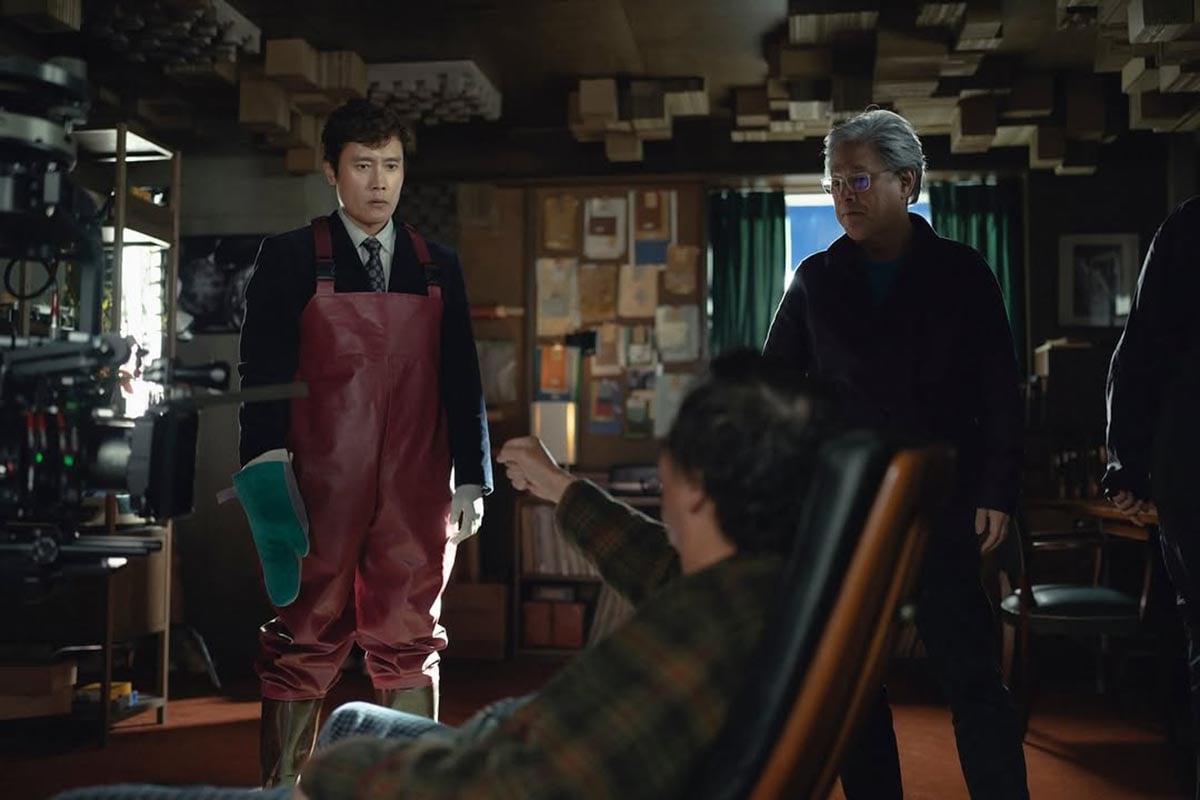
It took over a decade for Park Chan-wook to realize his big-screen adaptation of Donald Westlake’s 1997 novel The Ax. At one point, the project was even meant to be an American-set film, yet the stateside backing eventually fell through for Park’s mordant satire about the cutthroat nature of capitalism. But this story may have perversely benefited from the delay as it arrives amid the economic upheaval of A.I.’s mass application.
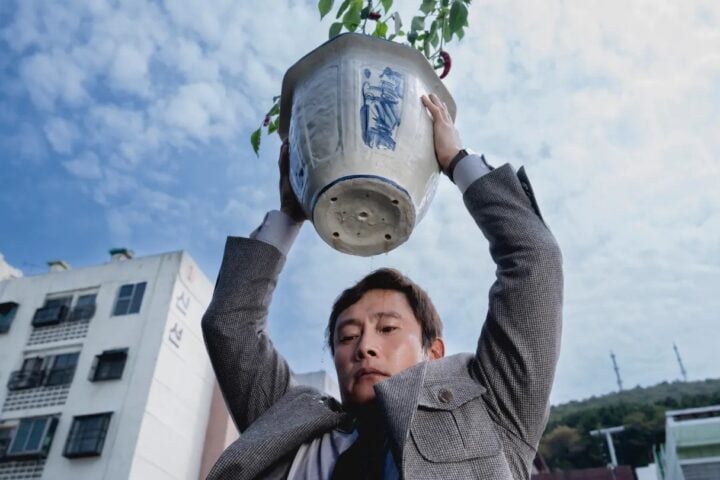
Park retitled his adaptation No Other Choice, and across the film “no other choice” is a refrain spoken by characters at all levels of the capitalistic food chain to absolve themselves of responsibility for harms caused by their actions. Lee Byung Hun’s Man-su, a longtime devoted employee at a Korean paper company, first hears those words when his management team informs him that he’s out of a job. After an extended period of unemployment, Man-su rationalizes that he himself has no other choice but to identify his chief competition for similar roles and systematically murder them to increase his own hiring odds.
The film unfolds with Park’s typical airtight compositional mastery. Which isn’t to say that Lee isn’t given the freedom to expose the raw nerves of a man pushed to the edge of his sanity. In many ways, Man-su comes to embody the ethos of the system that discredits the value of his labor to make way for A.I. automation. Beyond the laughs, thrills, and screams, the film offers a grim note of caution about what’s lost in a world that loses sight of humanity’s importance.
I spoke with Park and Lee ahead of No Other Choice’s theatrical release. Our conversation covered the nature of their collaboration, why Park kept the setting of a paper company from the novel, and what they can relate to in Man-su’s anxiety about unemployment.
Park, when this was still an American film, you said that you envisioned Jack Lemmon in the lead. Do you see any vestiges of that actor’s persona in Man-su, or was he thoroughly rewritten for a Korean brand of masculinity?
Park Chan-wook: Lemmon was [who] I had in mind back when I was developing this film and project, [but] he had already passed away. Another actor that I had in mind was Jimmy Stewart. For me, I think the modern-day Jack Lemmon or Jimmy Stewart is Lee Byung-hun, which is why I decided to cast him for the role. The reasons why I had these actors in mind for this role were their warm humanity and their sense of humor. I saw those same elements in Lee.
Lee Byung-hun: Whenever I’ve [worked] on a project that has an original [version] or is a remake, I ask the director whether I should watch or read the original. In terms of The Ax, it has a novel and a movie previously, but director Park told me that I didn’t have to watch it because so much had changed from the original to our No Other Choice. I think he wanted [me], and I also wanted to make this role my own using my imagination.
Something that did stay from the original story is that the protagonist works at a paper company. That’s been an essential good for centuries, but it’s a business that faces challenges in a digital world. What do you make of Man-su feeling such a strong connection to paper as an industry?
PCW: I think paper was the most appropriate choice to tell this story, and that’s why I think the original writer of the novel was so brilliant for choosing that. I considered changing it to other industries, but I just couldn’t find anything that was better suited for the story. Paper is very close to us in our everyday lives. We don’t value it, but it’s essential to our everyday function. You might think that because we live in a digital age, we don’t really need paper anymore. But because we live in a digital age, for instance, we get everything delivered through Amazon. That’s why the use of paper has actually increased through the making of those boxes. So paper is something that’s very close to us, but we actually never thought about the people who make these papers, and that fact was something that made this industry so interesting to me.
Many filmmakers consider filmmaking to be their entire life. But for an average person, a film might just be a two-hour-long source of entertainment. They might question, “Why do these people devote their entire lives to filmmaking?” That’s why, regarding this story about men who risked their lives to make paper, I could greatly empathize with those characters.
LBH: To add a little bit to what director Park already said, when it comes to the development of technology and losing to that, I think a paper company is really apt to give that example. And in terms of the development of A.I., I think every profession, to different degrees and maybe in different timelines, is being affected. So even though we work in the film industry, I think it has a lot of parallels to the paper industry because there are no set regulations that are in place yet, and we are feeling threatened by the development of A.I.
Employment in the arts is cyclical and project-driven, unlike Man-su’s factory labor, which is steady—until it isn’t. Do those experiences in your own industry factor into your understanding of the anxiety that drives the character so mad?
PCW: Earlier in my career, I’ve actually had many years where I was unemployed because my earlier films were commercial flops. Ever since then, I’ve really maintained that same level of anxiety all throughout my career because some of my works were commercial successes, and others weren’t quite as successful. Whenever that happens, I would feel this great sense of threat. I think I had that fear of job insecurity throughout my whole life and career, which is why I could strongly empathize with the characters in the story.
LBH: I’ve been lucky enough to not really experience Man-su’s employment issues. However, there were times when my family was going through some financial difficulties, so I would have to repay some debts for them and take more financial responsibility for my family. In terms of not having stability from one project to the next, I’ve been able to witness colleagues having difficulty with that, so these issues are really not too far from home for me.
Park is famous for his meticulous compositions, and Lee has said that he can find storyboards a little bit like a prison cell. How do you find a balance of getting what’s needed for the shot but keeping them alive on a performance level?
PCW: [laughs] I plan everything meticulously before going on set. But the true benefit of doing that is that, on set, I don’t have to spend time talking with my DP or my gaffer about the camera placement or the lighting. In other words, I can dedicate most of my time on set to conversation with the actors. Through these conversations, I’m always open to new ideas, and we think of new ideas on the spot. We do spend time talking about how to best execute what’s already been planned, but we also talk about new approaches that we come up with on set.
LBH: When actors prepare for a scene and go into character, they really focus on the flow of emotion within that scene. So when I look at a storyboard, you might think, “Oh, I’m not necessarily in this particular shot,” or, “They’re shooting the scene from the back, so it’s not as important.” I don’t really want to delineate the motion for each shot and would rather keep that flow of emotion. That’s why I try not to mull over the storyboard too much.
I check the storyboard at the top of the day to see what the flow of the shots is going to be, because I plan out the flow of my emotions when we go into shooting. For example, if there’s a full shot or a shot from the back when I feel like the emotion is really swelling, I’ll have a discussion with director Park, and we’ll discuss maybe adjusting the shot to really encompass that emotion so that it’s not broken up.
Lee has said that the difference between your first collaboration on Joint Security Area and your work here is that Park now listens to your ideas. Do you remember any of the ideas that Lee suggested that made the film?
PCW: One was the scene where the three people are fighting together, the gun slides beneath the cabinet, and all three of them are crawling and reaching beneath the cabinet to get a hold of it. Another idea of his that I really liked and incorporated is on Man-su’s second visit to the hill with the snake, and he’s wearing the rubber hand. Because he’s already been bitten by a snake once, he’s swinging the stick around carefully. Then, he mistakes the branch for a snake and jumps back in surprise. That’s one of his ideas that I really enjoyed.
LBH: Another moment that I remember is when Man-su falls asleep on the sofa because he’s so exhausted from digging the hole. He mistakes the police coming for arresting himself instead of his son. So he’s blubbering and says, “I’ll tell you everything.” That was a moment that I suggested because I thought Man-su might make that mistake.
Translation assistance by Isue Shin (Lee Byung Hun) and Jiwon Lee (Park Chan-wook)
Since 2001, we've brought you uncompromising, candid takes on the world of film, music, television, video games, theater, and more. Independently owned and operated publications like Slant have been hit hard in recent years, but we’re committed to keeping our content free and accessible—meaning no paywalls or fees.
If you like what we do, please consider subscribing to our Patreon or making a donation.