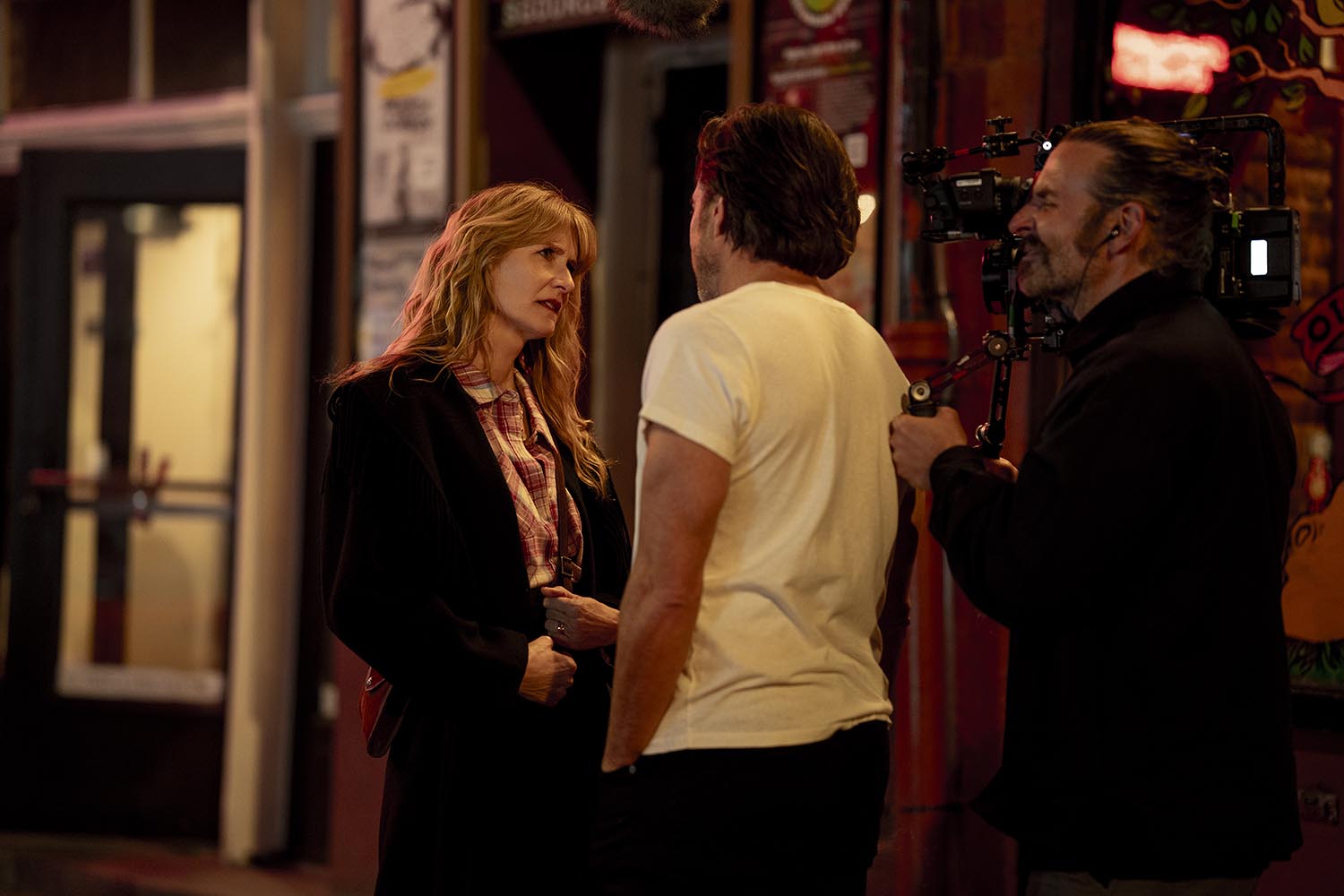
Robert Eggers’s remake of Nosferatu might not be the most obvious source of visual inspiration for a film that’s partly a tribute to New York City’s contemporary comedy scene. But for Bradley Cooper, Is This Thing On?’s director and co-writer, those boxy frames by cinematographer Jarin Blaschke illuminated how he could also use the 1.66:1 aspect ratio. Cooper’s decision matches the ethos of his film, which follows two characters learning to express their innermost desires in unexpected ways.
Will Arnett’s Alex and Laura Dern’s Tess, a long-married couple who decide to separate at the start of Is This Thing On?, go on parallel journeys that see them tapping into their passions. For Alex, who’s loosely based on events in the life of British comedian John Bishop, it’s the discovery of stand-up as a mechanism to process the transformations of his life. Tess, on the other hand, begins the rediscovery of what volleyball once meant to her as a former Olympian as she weighs whether to take a high-profile coaching job for the 2028 Summer Games.
These two people might appear to be drifting apart. However, their midlife crises allow them to find the spark in their relationship once again. Among its many virtues, Is This Thing On? is a clever comedy of remarriage rooted deeply in the recognition that partners must grow and change so that they can maintain the stability of their union.
I spoke with Arnett and Dern ahead of Is This Thing On? opening in theaters. Our conversation covered how Dern’s casting transformed the project, why they resisted intellectualizing their characters, and what it meant for Cooper to serve as a camera operator on the film.
This project started with Will and his writing partner, but transformed when Laura came on board as Tess. How did she reshape the character and the film?
Will Arnett: In every way. [both laugh]
Laura Dern: We have to give Bradley a little credit!
WA: But Bradley said as we were in the rewriting process, this character of Tess needs to be—forgive me, he used the words “titan” and “beast.” She needs to be somebody really formidable…
LD: Tall.
WA: And tall as well, because I’m relatively tall. And [someone] who really you can believe has this killer instinct, who’s got this drive, who’s very confident, who knows who she is, all of these things. And he’s like, “Laura Dern.” And I thought, “Okay, that’s a great wish list. Who’s going to do it?” But when Laura said yes, it changed everything. Well before we started shooting, like a year and a half, Laura started bringing all these ideas and thoughts about who she saw Tess as, who she should be, and her trajectory. It was just lights out from the moment she said yes, right to this moment with you here today.
That’s where it was all leading! Laura, you’ve mentioned your appreciation of the screenplay’s not articulating things the characters couldn’t know about themselves. When you don’t have that in the dialogue as actors, where do you turn to understand the character?
LD: [points to Arnett] Genuinely, actually, I think we turned to each other to not do, which I’m so moved by. Bradley was an incredible guide in this. We didn’t do what actors traditionally do, which is get together, have a meal, and decide what the character’s backstory is. How long did they date? Where did they first meet? That’s intellectualizing it. And we immediately, with Bradley’s guidance, worked into the depth of understanding who we are, how we got here emotionally, our childhood experiences, our love stories, our longing. We went there, and I felt I knew him like my most intimate relationship before we ever started.
WA: And what’s interesting is never in the dialogue, script, or anywhere in the stage direction does it say, “Tess goes into the shower, picks up her kid’s toothbrush, and is affected by it,” or crying about it, or struggling to deal with it. None of that. She’s going to take a shower while she’s at Alex’s apartment, and Laura and Bradley work through that process of doing the staging and what that looks like cinematically. Laura finds and inhabits Tess in that moment as if Tess were doing that. And that’s the beauty. I remember just watching the first time when that came back, and Bradley and I were watching, going, “Wow.”
LD: Like me watching him fold the laundry. Oh my god, that killed me.
WA: Again, that [scenario] was: The kids aren’t here, you’ve got their laundry, you’re going to take it out of the dryer and fold it on the counter. What does that mean? Well, let’s find out. To Laura’s point, if we go like, “Hey, he’s gonna go fold the things, and he’s really moved by it,” well, now we’ve already decided what it is. Let’s see how these people would behave in that situation. Whatever their behavior, the moment will tell us what it’s supposed to be.
Did that ever play out in a scene together?
LD: One of my favorite moments, as an example, is when he comes to ask if I’d take the kids at the front door. It almost inferred a flirtiness in the writing. We met at that door, and we’re just so resentful of each other within seconds! It just happened that way.
WA: We both felt rejected in that moment, then protective, and then the worst thing we say to each other is, “You suck.” They’re like two kids whose feelings are weirdly hurt in that moment.
LD: But that just happens because you promised a deep connection. You know all of this within each other, and then you have Bradley allowing the room to discover [that] in real time. Matty [Libatique], our DP, had a language of cinema and a crew that made it work. They got everything, no matter where we were or what happened. We captured it, and that’s such a gift.
And Bradley camera operating, too, had to have helped.
WA: One hundred percent, and this is the benefit of his knowing us so well—the fact that the three of us are friends. He knows in that moment. He’s got a pretty good idea. He doesn’t say, “Hey, this is how you’re going to react, and this is how you’re going to react.” He puts us there. He sets up cinematically how that’s going to go down, and he knows something’s going to happen given the way that he’s framed it and the way that he sees the scene playing out.
Since 2001, we've brought you uncompromising, candid takes on the world of film, music, television, video games, theater, and more. Independently owned and operated publications like Slant have been hit hard in recent years, but we’re committed to keeping our content free and accessible—meaning no paywalls or fees.
If you like what we do, please consider subscribing to our Patreon or making a donation.