

“Childhood is a disease—a sickness that you grow out of.” That quote, attributed to William Golding, would seem to be the jumping-off point for The Plague’s exploration of teenage social hierarchy at an all-boys athletic camp.
Saturated with the type of pre-adolescent provocations usually reserved for young girls in cinema, writer-director Charlie Polinger’s feature debut takes notes from Catherine Hardwicke’s Thirteen, as well as from Catherine Breillat and Céline Sciamma, longtime doyennes of coming-of-age terreur. But Polinger’s visual and thematic touchstones also include such hypermasculine visions of alienation as Claire Denis’s Beau Travail and Stanley Kubrick’s Full Metal Jacket.
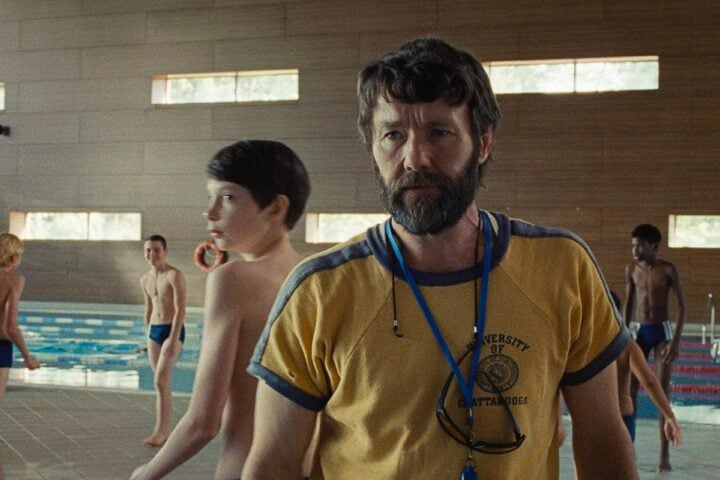
In the summer of 2003, Ben (Everett Blunck) attempts to ingratiate himself with his fellow bunkmates at the camp. Anxious and smarting from his parents’ recent divorce, the scrawny 12-year-old manages to get on the good side of Jake (Kayo Martin), the insolent leader at the top of the social ladder. At the bottom is Eli (Kenny Rasmussen), who’s ostracized for his awkward manner and skin rash, which Jake and his cronies claim is a “plague” that can infect anyone he comes in contact with. As the scapegoating becomes too much for Ben, his attempts to foster a friendship with Eli threaten to upset his good standing in the pecking order.
Probing and meditative, the film’s unearthly underwater photography (Sciamma’s Water Lilies comes to mind) and fly-on-the-wall camera setups seem to throb with the barely contained frisson of threat that characterizes Johan Lenox’s score. Droning organ tones give way to chants and breathless vocalizations, injecting Polinger’s stylish images with a slow-boiling panic—like skinny legs kicking frantically beneath the surface of comparatively calm waters.
As Ben shifts between pitying Eli to feeling anger at his new friend’s ambivalence toward fitting in, Blunck is tasked with handling emotional beats that performers decades his senior might crumple under. From jeering cafeteria lunches to group masturbation sessions and sadistic pranks, Ben is at once discomforted by and drawn to his cohorts’ social rituals. Emblematized by the boys’ coach (Joel Egerton), authority figures are pitifully ill-equipped to deal with or alleviate Ben’s pain, and The Plague is vividly, terrifyingly attuned to the way children create a social order that resists sensible adult intrusion and influence.
The film’s title refers to the cruel game involving Eli’s rash that’s weaponized against him and Ben, but given that we’re living in a time when we’re finally coming up with language for talking about male loneliness, it might also be that Polinger is asking us to consider the gendered toxicity that’s always been a part of everything from politics to dating to popular media as viral in nature. To contradict and paraphrase Golding, the toxicity of male youth isn’t a sickness you’re guaranteed to grow out of. If you’re not careful, it simply metastasizes into manhood.
Since 2001, we've brought you uncompromising, candid takes on the world of film, music, television, video games, theater, and more. Independently owned and operated publications like Slant have been hit hard in recent years, but we’re committed to keeping our content free and accessible—meaning no paywalls or fees.
If you like what we do, please consider subscribing to our Patreon or making a donation.




Given the overt misanthropy of William Golding as expressed in his ‘Lord of the Flies’, it is no compliment to this work to compare it with his.