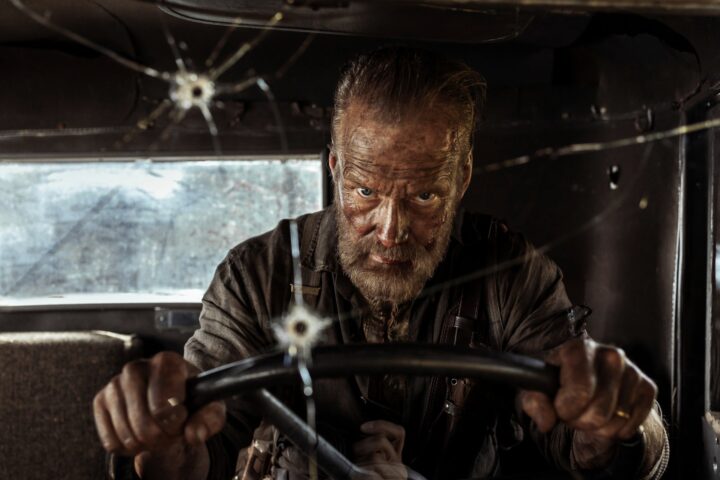
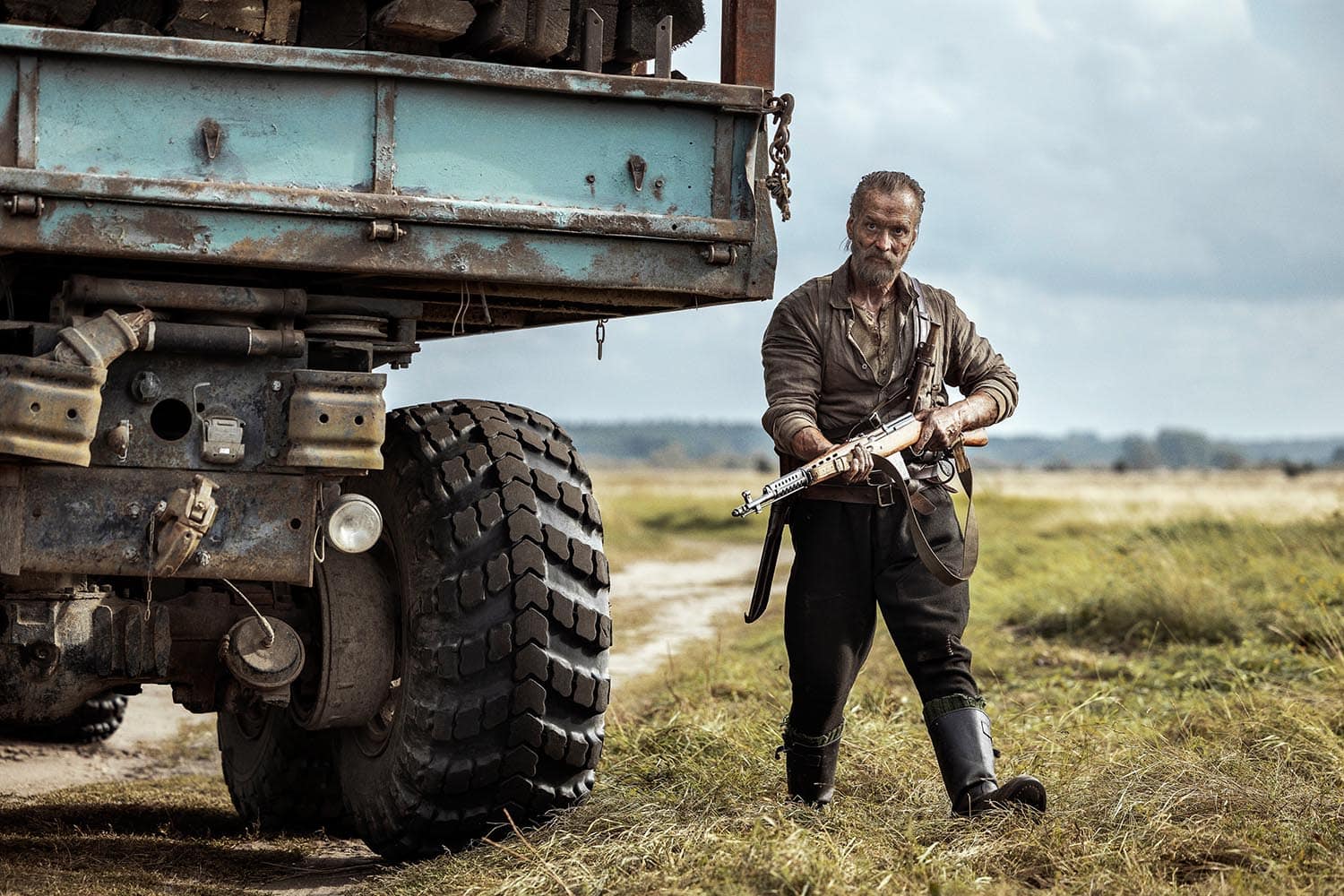
After putting his name on the proverbial map with the spirited (and bloodied) yuletide fable Rare Exports: A Christmas Tale, Finnish director Jalmari Helander hit a new career high with WWII-set actioner Sisu. Starring a grizzled Jorma Tommila as a legendary Finnish soldier named Aatami Korpi, the film is set at the tail end of the conflict with Korpi waging a one-man war against a band of Nazis led by Aksel Hennie’s Bruno Heldorf.
The film became a sleeper hit, and Sisu: Road to Revenge ups the ante and then some. Aatami, “the man who refuses to die,” this time faces off against Soviets led by Igor Draganov (Stephen Lang), the commander directly responsible for the deaths of our hero’s family during the war. In search of a new home for himself and his trusty beloved Bedlington terrier, Aatami has to drive, punch, stab, and throttle his way through scores Red Army soldiers to find a sense of peace.
I recently sat down with Helander to discuss his influences, his favorite set pieces, and what home means to him now that he spends so much time abroad.
I’m curious to know what were some of your favorite childhood movies, and which ones specifically influenced the Sisu films?
Well, Indiana Jones, for sure. James Bond. Buster Keaton films, I love all of them. And, of course, First Blood is one. When I was 10, that was a pretty important [film] for me.
Are you a fan of Mad Max at all? The first act of especially invites comparison to George Miller’s film.
No one knows where exactly [influence] comes from, but, of course, it’s a mixture of all the stuff that I like. No one is doing action [in Finland], [so] it’s been hard for me [laughs].
Why is it hard?
Everyone just thought that I’m a fucking idiot for trying to do it, so I proved them wrong.
Why do you think Nordic countries tend not to make action movies?
Probably because there aren’t too many people living [in the region] and it’s usually pretty expensive to do an action movie. You don’t get that kind of money easily, and you have to have an international audience.
You shot the first film in Finland, but Sisu: Road to Revenge was filmed in Estonia. What was the reasoning behind that change of location?
Yeah, at first I thought I would do it up north, in Finland, Norway, or somewhere, but there are a couple of reasons why it was impossible, like getting permission to blow everything up. Estonia’s closer [than Norway], and it was the best place to do it. I liked [working there]. I think it’s cooler to make a film when you’re in the middle of nowhere and you just have all the crew there and there’s no other places you can go. I think it feels better, and you build a better team when you’re just there alone in the wilderness.
What is the screenwriting process like for a work so short on dialogue?
Slow [laughs]. At least, the first one was a bit tricky, because the length of the script usually comes from the dialogue…it gives you more pages. So, it was really difficult trying to think about the length, because usually it’s like a minute per page, but the Sisu screenplay was something like 60 pages. Like A Quiet Place. That first script was something like 40, because you’re just describing action and what you see. So, it’s difficult.
How did you try to differentiate the Nazis in the first film from the Soviets here?
It was easier with the Nazis because it was this one outfit basically, which I had a couple dudes following, and they were evil motherfuckers. I think in this second one, I’m not spending that much time with anyone else, but basically Lang’s [character] and all the others are just soldiers.
Do you have any personal connection to World War II?
Yeah, I guess everybody in Finland does. Both of my grandfathers were in the war. My father’s father had grenade shrapnel in his arm. His foot was paralyzed. We all know [a lot about] it because it was a pretty fucked up time.
What really struck me most about the film is the visual metaphor of Aatami literally dismantling his home to take it with him, Lang’s character threatening to turn the planks into railroad ties, etcetera. It feels very connected to the national identity of Finland. What does home mean to you, especially in this context?
It’s getting more and more important to me—meaning how important my actual home is to me and my family, but also Finland, because I’ve been so much away from Finland nowadays. I’m starting to appreciate a lot of things that I thought I wouldn’t like that much. Even winter. I’m spending a lot of time in Thailand, which is really hot. I think it’s important to have a home which you love and yeah, Finland is getting more important to me day by day. I don’t know why.
How would you say that Aatami’s struggle to find a home embodies sisu—that untranslatable Finnish word that’s about fighting against the odds, especially when there’s no hope left?
Well, Sisu and [this film] say a lot about that, but without going into any politics or stuff. I just thought it would be cool to make a story about someone that just wants his home back. He’s not trying to hurt anyone or do anything bad. He just wants it back, to build the house himself because family is something that he doesn’t have anymore, so at least he can have his own.
And Aatami’s desire for a place of respite to call his own is sort of borne out in the concluding scene…
I’m really proud of that scene. Because the fact that Aatami is used to, like, if people approach him, it’s gonna be a fight. Somebody’s [always] trying to kill him and [we see] how hard it is for him to realize that maybe that’s not the case, at least this time.
It’s clear that Buster Keaton has a huge influence on the film, but how do you come up with such new, novel types of action movie mayhem?
I don’t know. I’m just fucked up like that. I don’t know. But it’s hard work, I’m now specialized in trying to invent weird ways to kill people, so…
You just lay in bed at night thinking about it?
Yeah [laughs]. It’s a weird profession.
Are there any big action moments that you couldn’t accomplish here that you may try to revisit later?
The only thing that comes to mind is the end fight, because originally, the last bit was like 90% longer, which no one seemed to like. I needed to cut it…I went too far. I even knew when I was filming it, “I’m going too far now.” But I needed to find that. It’s cool to find the line that you can’t cross anymore, because then you know that you have gone long enough and that there’s not room anymore. I like to find that place.
You’ve spoken about how, after such a breakneck opening, you were worried about slowing things down a bit during the last act, but I think the sequence with the soldiers in their bunks in the train car is one of the film’s highlights. How do you navigate hitting those peaks and valleys?
I don’t know. I just have to do what feels good. That [scene] was my favorite thing to shoot. There’s so much more I can do [with a scene like that] because I’m there with the guys, with the camera, instead of being in like a moving car with a big crane on top and everything is going around you. It’s much more controllable to create some things on the spot.
What do you hope people take away from Sisu: Road to Revenge?
Emotion and the joy of an entertaining movie.
Since 2001, we've brought you uncompromising, candid takes on the world of film, music, television, video games, theater, and more. Independently owned and operated publications like Slant have been hit hard in recent years, but we’re committed to keeping our content free and accessible—meaning no paywalls or fees.
If you like what we do, please consider subscribing to our Patreon or making a donation.