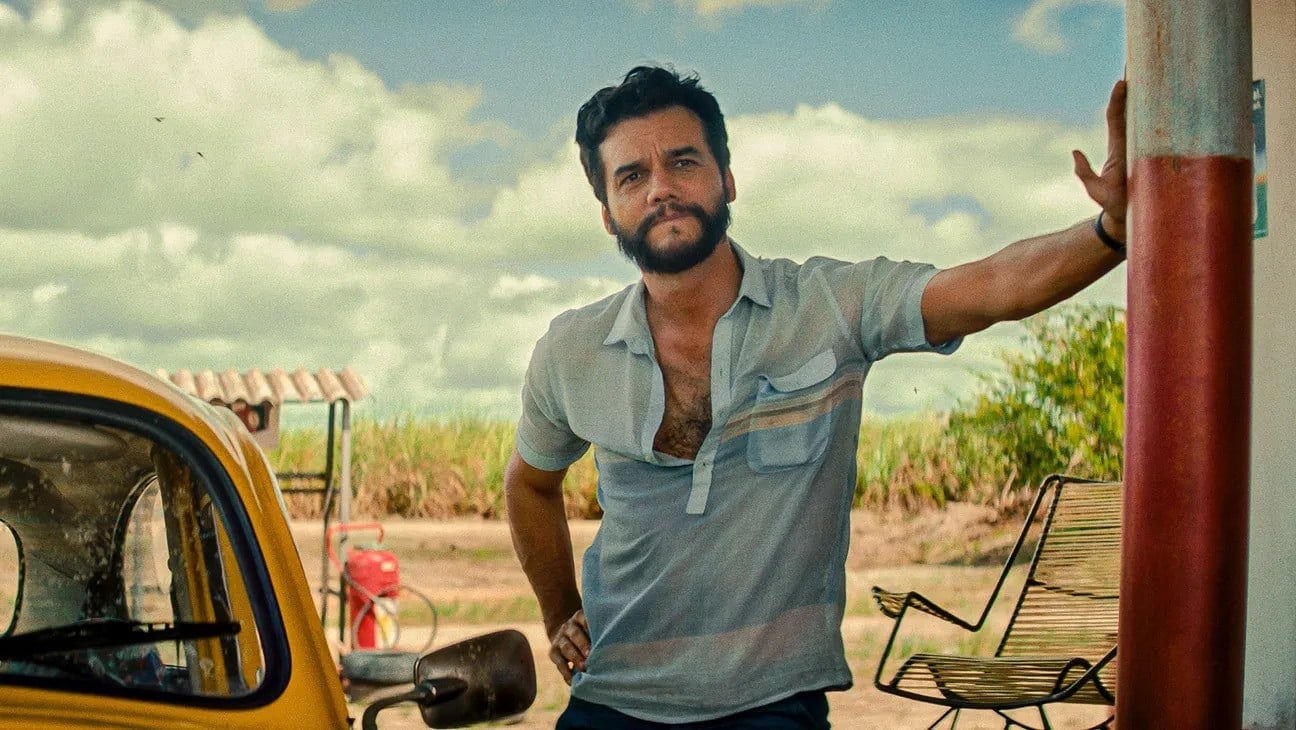
“I’m concerned not only about my ideas being recorded by you, and you reinterpreting them in your text,” Kleber Mendonça Filho says early in our conversation about The Secret Agent, “but also how they will be interpreted in 50 years, if this piece of audio survives.” The metatextual dimension of the Brazilian filmmaker’s words is apt given that his latest feature frames its ’70s-set story through a contemporary archivist listening to recorded tapes. Among other things, that device underscores a sobering reality: that the present, no matter how vividly experienced in the moment, will inevitably become other people’s past.
A week before I spoke with Mendonça Filho and Wagner Moura, the latter had roused pro-democracy protesters in his Brazilian hometown who rallied against proposed legislation to pardon former President Jair Bolsonaro. The actor expressed pride in his country’s populace learning the lessons from periods of democratic backsliding, be it the dictatorship that forms the backdrop of The Secret Agent or Bolsonaro’s tenure that culminated in 2022’s attempted coup.
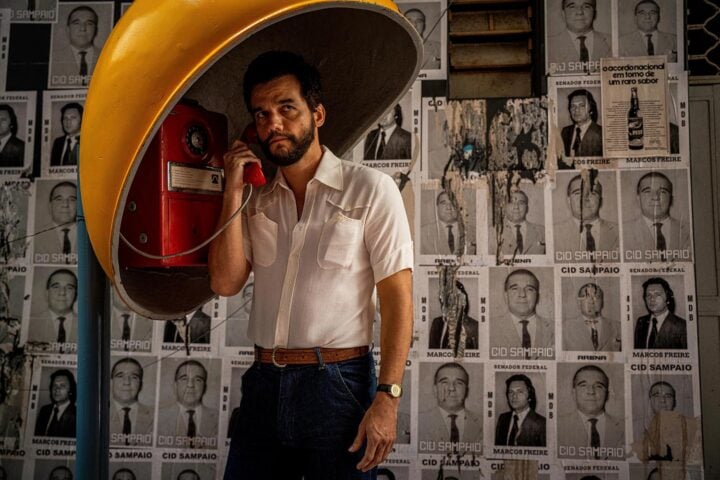
As we chat during the first weekend of the New York Film Festival, Moura has stepped away from rehearsals for a play set to open just days later back in Brazil: a modern update of Henrik Ibsen’s An Enemy of the People. Moura claims that the production’s fiery protagonist’s raging against political injustice matches his own temperament more than Armando, his character in The Secret Agent. Moura’s political refugee in the film is attempting to lay low in the northeastern city of Recife and evade retribution from former enemies.
While attempting to secure a future for himself and his son, Fernando, with passage out of Brazil during the waning years of the dictatorship, he cannot fully cut the tether to his past without achieving some resolution of an unanswered question surrounding his own history. Under the alias Marcelo, he works at the city’s social registration archive to provide for himself, but also to locate some record of his late mother, of whom he retains almost no memory. Mendonça Filho brilliantly contextualizes Armando’s struggle as representative of an entire nation’s journey to escape the clutches of tyranny as well as properly reckon with its legacy.
In addition to themes of democracy and memory, my chat with Mendonça Filho and Moura covers the role of cinema in making social change, the nature of Moura’s multiple roles in The Secret Agent, and the meanings nestled in a brief appearance by Udo Kier in the film.
Wagner called out at last night’s screening that people in the crowd shouted “sem anistia,” meaning “no amnesty.” What does it mean to be showing this film right now, given the way its themes of historical memory interact with the present debate around how to handle the lingering pains of the past?
Wagner Moura: It always fascinates me that a film is always [more than] what a director and writer wanted to say with it. It’s also the conjunction of that with a particular audience that sees the film at a particular time. If Bolsonaro hadn’t been sentenced, we’d probably be having the same question with Bolsonaro free, like, “How do you feel about this?” And I love that. But it feels great! We are very proud of being Brazilians right now, and that doesn’t happen that often. I’ve never thought that the Brazilian democracy would be a template for the rest of the world, and it is. It feels great to be releasing a film that takes place during the dictatorship, in a moment when Brazil is finally doing the right thing.
You also spoke at protests that were headlined by musicians like Caetano Veloso and tropicalía artists who were part of a resistance to the dictatorship. What role has cinema played—or what role can it play—in inspiring action off screen?
WM: It was beautiful to see these men on the stage.
Kleber Mendonça Filho: Sixty years ago, they were doing the same thing. Film is part of culture, living in society is part of culture, and politics is part of culture. I find it really hard to accept when there’s a discussion about filmmakers, and somebody says, “No politics here, please, in this conversation.” I find it really hard to accept that request because everything is politics. Cinema, just like poetry, journalism, music, or a conversation between two friends, offers a mirror to life in society. I find it beautiful that films will be truthful in terms of expressing our desires, our fears, and the bizarre difficulties that we face living life in society. I think that’s what I do. That’s not really my mission, but that’s what the films can be at some point. The Secret Agent is a look back on history, but in fact, it’s very much about the present.
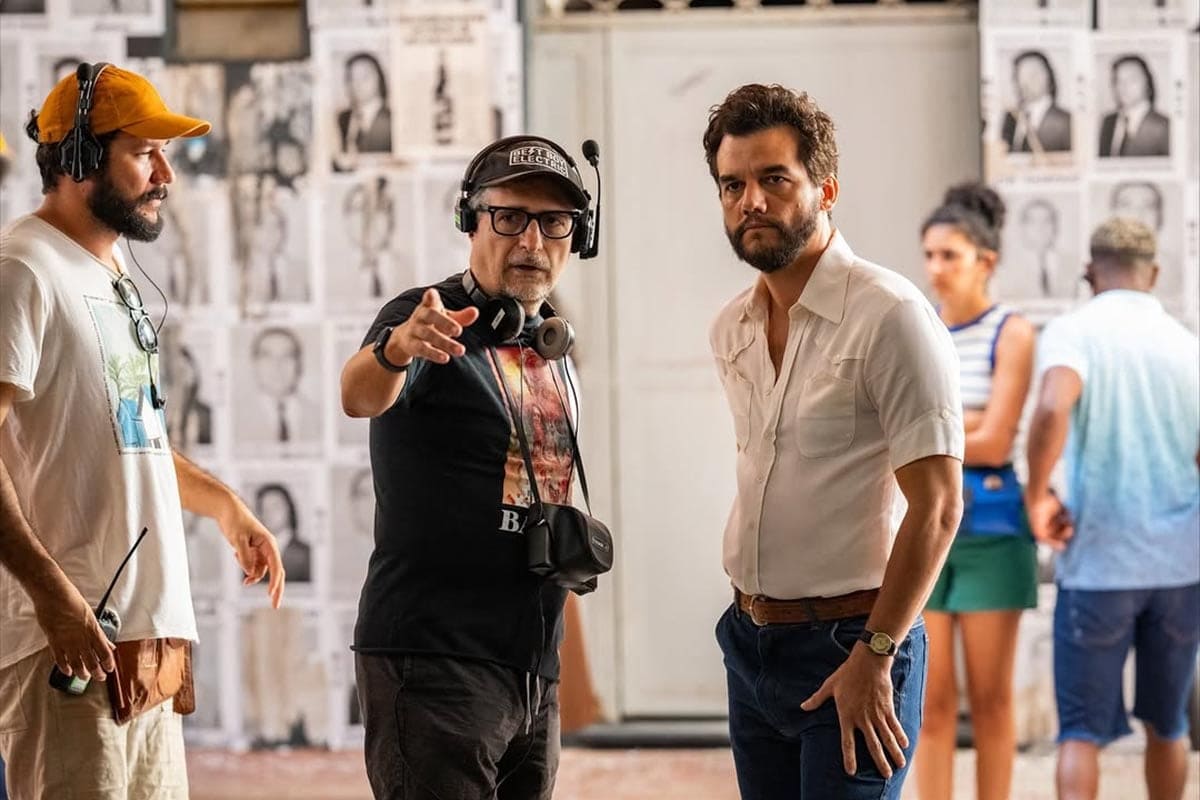
Thinking about that interplay between time, how did you come to intersperse the flash-forwards throughout the film rather than only placing them at the end like an epilogue or coda?
KMF: I think there’s something very dramatic in knowing that the story we’re watching is actually being observed from the future. When you change the point of view, I think the story becomes stronger, in an interesting way, because now you have the benefit of time. When you do that, you begin to get worried because you wonder, “What happened to these people? What happened to him?” When I was doing research—and it might have been for Pictures of Ghosts—I remember I came across a picture of a woman in the socialite section of the newspaper. And I happened to find this woman very beautiful, very striking.
WM: From the ’70s?
KMF: Nineteen seventy-four. I thought she was beautiful, but it wasn’t really a sexual thing. And then, I took her name down, and I decided to do a full search on the database. I discovered that she died in 2015 at 77, and I saw a picture of her in her 70s. It was a very strong feeling, because in ’74, she was 36. This woman had a full life, and then I saw her just before she died. This is an archive. This is what I wanted to put in the film, that feeling of discovery and shock.
There’s a title overlay that describes Brazil in 1977 as “Um tempo de muita pirraça,” which translates to “a period of great mischief,” and later in the film, the idea of “less mischief” is used to describe the hopes for a better Brazil. Does that have a specific cultural meaning, or are we meant to read out of it what we choose?
KMF: “Pirraça” is a wonderful word. It’s kind of old-fashioned, and maybe very young people don’t quite know what it is.
WM: I think it’s very northeastern.
KMF: It’s probably very much from where we come from, less known in other regions. But I like the use of it because it sounds poetic, strong, and a little harsh. And, at the same time, it grossly understates what happened in the dictatorship. Because the usual way would be, “This is 1977, Brazil is under a dictatorship.” There’s nothing wrong with this classic way, but you should feel a little more unsafe reading that opening line.
WM: That sounds funny to me. There’s some grace in that [saying].
KMF: Of course, there’s grace. But knowing history, you know that’s not really “pirraça.” Getting tortured and raped isn’t “pirraça.” It’s more serious.
Kleber, you wrote the role of Armando specifically for Wagner and tailored it toward something that people hadn’t seen you do before. Wagner, what do you feel that was, and how did it challenge you to grow as an actor?
WM: With the characters that I play, and in my personal life, I react to injustice and things like that with more explosive behavior. I’m more like, “Fuck you, fuck this shit!”
KMF: Which you do in the film!
WM: Which I do in the film, but in three moments. He cannot behave like that. He has a kid to take care of. But I think it’s beautiful the way he goes through [life]. I would say the word “stoic,” but it’s better than that because there’s some humor. There are some contradictions. I like the fact, for example, when he just received the news that he’s about to get killed by these two guys, and then he goes out of the movie theater and gives himself to the carnival. These things are so complex, the way we are in our lives. We’re not always [so serious]; we can laugh about ourselves. There’s a temperature in the character that isn’t the temperature that I usually play in my characters or in my own life, and I think it comes from Kleber. It’s his temperature. This is the way he behaves in his life. I think he identified that explosiveness in the things that I do, the fact that he didn’t want me to pack a gun and things like that, and he modulated.
A line that stood out to me, when the refugees talk about facing death threats, is Armando saying, “I want to live.” It’s short and simple, but it speaks volumes about his character. What does a line like that tell you about him?
WM: He’s never a victim. He’s never like, “Oh, fuck. I’m so fucked.” He’s like, “I want to live. This is fucked up, but I have a son. I have a reason to live, and I’m gonna do the best I can to live.” I love characters that have the will to live. That’s why, in cinema, I always love to see characters dancing. I love to see characters fucking…when it’s well-shot, of course. I love to see characters that want to live and want to be alive. Our character has this temperature that we talked about, but he fights desperately for his and his kid’s life to the end of the movie.
KMF: I would never, and neither would Wagner, do the sadsack, depressed, “Oh, they want to kill me” kind of thing. He’s just very much alive, and he’s healthy.
WMF: He’s strong, but he shows vulnerability, too. He’s not a machine.
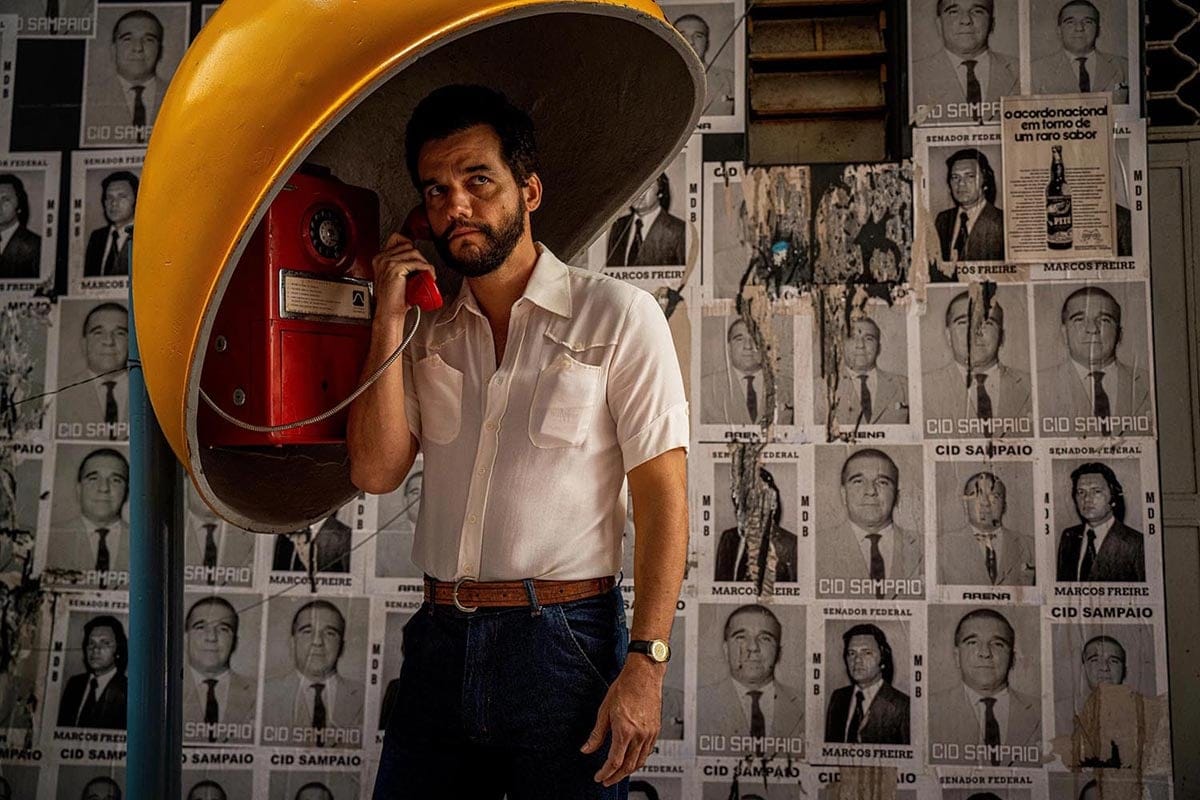
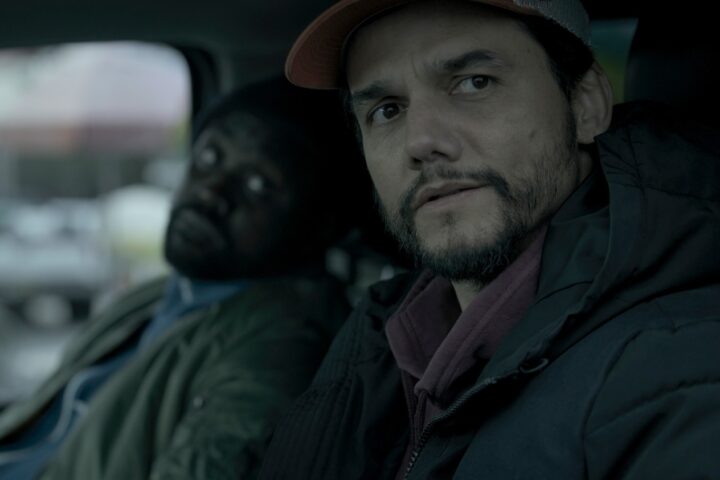
Wagner also plays Armando’s son as an adult at the end of the film, who cares much less about his father compared to the researcher who’s fascinated with his archival tapes. Does this desire to remember feel like something cyclical?
KMF: The son, it seems to me, has to deal with the traumatic incident of losing his father. Then, probably by being brought up by his grandparents, they were also [dealing]. I’m psychoanalyzing my character, but come on. They were both traumatized by the loss of their daughter, so they probably brought that kid up not even mentioning his parents.
WM: I think there’s something that goes beyond that. Your film, Kleber, is a lot about memory and the importance of keeping memories. Not only the individual memory, but the memory of a country. Recently, when people were saying, “No amnesty,” what they’re saying is that we don’t want this to be erased from our history again. I mentioned the amnesty law that we had in ’85, and they’re trying to do that again with Bolsonaro and all these military people who got the worst sentence. We don’t want that anymore, because we have to remember. We have to remember so that doesn’t happen again. Fernando grows up not really knowing who his father was and reading shit in a newspaper that wasn’t who his father was, that his father was corrupt and things like that. Therefore, when he receives that pen drive, it’s hard for him to take it. Maybe he doesn’t want to. This is a bad symptom of not only psychologically [for him], but for the psychology of the whole country. We have to remember, and the history has to be told correctly. These films have the ability to show things. Not pedagogically, but through art.
KMF: I was just in Spain, San Sebastián and Madrid, and I was very struck by how the Spanish [journalists] systematically, interview after interview, mentioned the Franco era and how Spain hasn’t been able to deal with what exactly happened. Who were the fascist families? What happened? How many people were killed? Who was killed? Where are they? Spain doesn’t want to talk about this, so it’s a very disturbing subject and metaphor for the Spanish.
What does that small but critical scene with Udo Kier as the Holocaust victim mistaken for a Nazi soldier mean to you?
KMF: I love that scene on a number of levels. First of all, Recife has a strong Jewish community. It’s just part of what the city is. The second thing is, I really believe the far right gets things wrong. They don’t understand things. For example, Hans, Udo’s character, is a tailor and a gay man who has a Brazilian partner. Euclides seems to believe that because he’s German, he’s a former Nazi soldier because he has all the war wounds to prove it. But that’s not who he is. He’s a German Jewish man who came to make his life in Brazil. And then, for a number of reasons, he plays the game almost like a circus attraction. They get protection since they are part of the community. His partner is black, so it’s a very complex power situation.
But then again, it’s so horrifying and humiliating what Euclides does without understanding the context. And then he brings Marcelo [Fernando’s alias] along because he wants to bond with Marcelo. I really believe Euclides has a man crush on Marcelo, so there’s a lot going on in that sequence. Many people love it, but a few people will say, “I didn’t understand that sequence.” I don’t know how to explain it, but there’s a lot going on there. It’s very much about history, again, and memory. He has a personal archive in his body. The documents are all in his scars.
The final scene of the film takes place in a blood bank that exists in the building once occupied by a cinema. Is that something you feel holds metaphorically true, too, that film is a life-giving force?
KMF: Cinemas are a life-giving force. Of course, I love that idea, but I have to be very honest with you. That’s the Boa Vista cinema, where I saw Star Wars in 1978. I also saw, when I was little, The Island at the Top of the World, which was a Disney film. In 1980, it closed. For many years, it was supermarkets and different things. And today, it’s a blood bank. It’s a real, private blood bank. I couldn’t make that stuff up. Of course, I find it a beautiful idea. Of course, I want to write that into the script. And yes, I do believe that cinemas are life-giving organisms. I love that ending, and I love that image. Especially when we cut to it, when you can tell from the shape of the building that it was a cinema.
Since 2001, we've brought you uncompromising, candid takes on the world of film, music, television, video games, theater, and more. Independently owned and operated publications like Slant have been hit hard in recent years, but we’re committed to keeping our content free and accessible—meaning no paywalls or fees.
If you like what we do, please consider subscribing to our Patreon or making a donation.