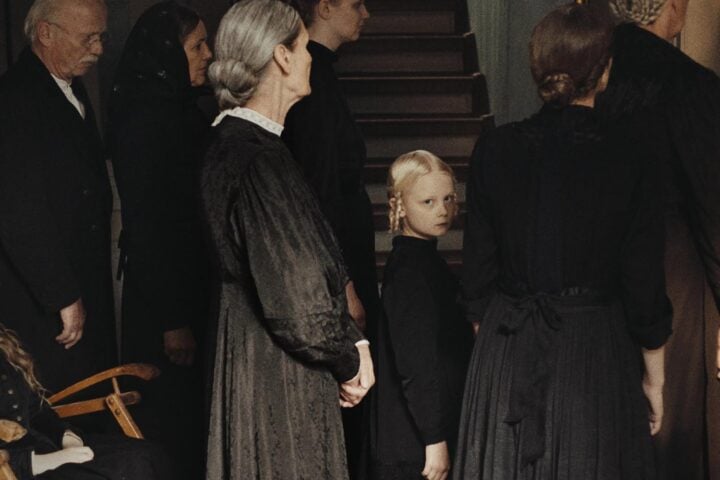
The description “novelistic” is often used to describe films with intricately braided storylines and a literary way of developing their characters. Mascha Schilinski’s intimate epic Sound of Falling, Germany’s submission for best international feature at the upcoming Academy Awards, very much earns that epithet.
This dense and devastating film follows four young girls, each in different time periods: the 1910s (Hanna Heck’s Alma), the 1940s (Lea Drinda’s Erika), the 1980s (Lena Urzendowsky’s Angelika), and the 2020s (Zoë Baier’s Nelly). Their initial point of connection appears to be the family farmhouse in Germany’s northern Altmark region, where they all live. But Schilinski and co-writer Louise Peter knit the fates of these characters together in other unexpected ways, which is teased out gradually across the film’s 149-minute runtime.
Sound of Falling tracks the transmission of trauma, both as it passes through time and seemingly gets trapped in the physical structure against which the dramas play. Schilinski masterfully layers visual and aural texture on top of these narratives to create a work that’s endlessly surprising in its revelations but remarkably subtle in its execution. Yet even inside her meticulous design, she leaves room for mystery and mysticism. What an audience doesn’t know—or cannot know—proves just as integral to experiencing the film in its totality.
I spoke with Schilinski in New York when she was in town to promote the film’s Oscar-qualifying release. Our conversation covered how she approached the film’s sound design, her research into the reverberations of trauma, and her work in the editing room.
Sound of Falling toggles between so many ways of representing perspective, be it through the camera or voiceover narration, just to name two. How did you determine the right mode of expression for any given moment?
Fabian Gamper, my cinematographer, and I discussed capturing this feeling that you can’t reach a memory anymore. “Is this a real memory, or is this even a dream?” You only know that the feeling is real, but you’re not sure if this image that came up in your mind is real.
We decided that Fabian’s camera, which he operated on his own, must be like a ghost. He’s really floating from one time to another, from room to room. He started to dance with the actors, in a way. And you don’t know which person [the camera] is or what it’s looking for, but maybe the characters themselves are looking back and can see each other. There was also the idea of capturing that these women are looking into the world, and the world is looking back.
As for the voiceover, I wanted to create this stream of images, memories, and consciousness from every point of view of the ancestors living at this place. There was this idea to find a way to offer another look beyond the obvious, and the sound is helping us cut between [images] and tone. You feel that the language used in the voiceover is different from what you see in the pictures. You have this feeling of disconnection, and you can feel, “Oh, there is even more to explore behind these pictures.” The pictures that you see are important, but the ones you don’t see are even more important because it’s about what you have to suppress to survive.
Were the actors aware of the perspective that their characters were being seen through? Were they aware, for example, of whose memory they were in or who the camera was seeing them as?
I wrote the screenplay with Louise Peter [across] three-and-a-half years. Everything you see is written into the screenplay, [which] was our communication tool [with the actors]. But there were some scenes where I kept it open for them. And also, for myself, it was just a feeling. I knew there was a point of view, and there were some options for how you could see [a scene].
Were you looking outside of cinema for aesthetic inspiration at all?
We were discussing a lot of these subtle questions that we wanted to explore—what is written into our body, what determines us long before we were even born, all these phenomena of transgenerational trauma. We wanted to create a film that’s all about these invisible things that are more the quality of literature. We asked ourselves, “How can we turn it into a film? Maybe we have to do sound installation or write a novel.” And then we found this incredible place [to shoot the film], and this became a vessel for all these questions that we wanted to explore.
We wanted to really go deep into the small details. We wanted to feel the pulse of each person. It’s about these invisible, broken things that are inside of people. It’s about shame and all the stories that you will never tell anyone. This was also why we chose to use voiceover.
I’m fascinated by the concept of “phantom pain” that comes up in relation to the amputations in the film. Do you see cinema as a form of phantom pain, a force that makes us feel something even though it’s not a part of us?
Interesting point! Yes, maybe. Of course, film is like a ghost material, and this film is also about ghosts that are living inside of us. This phantom pain becomes a metaphor for the invisible thing that we don’t know about because it’s [from] a long time ago, but it determines [our lives].
There is a framework, “the body keeps the score,” that’s a popular way of understanding how people physically hold on to trauma. Were you thinking about the literal processes of how human bodies and physical structures trap trauma? Or was it all in a more metaphorical dimension?
We did a lot of research about transgenerational traumatization and how these traumas are written into our bodies over a few generations. We wanted to create something that we can’t see in regular life—a full look into a life before and a life after, and to see what echoes exist [across generations]. We were collecting a lot of stories around us, like phenomena. But of course, we were discussing a lot of psychological aspects of this. It’s very fascinating [to] get deep into those materials [and discover] what kind of stories every person knows. We were interested in these questions of where we often feel betrayed by our bodies. There’s a scene in the film where Angelika says, “Oh, you blush.” In a moment where you really want to hide something, your body is more transparent to other people than you are.
The sonic design feels deeply ingrained in the fabric of the film. How did you develop this approach that often strays from sonic realism—and underscores some of the most powerful moments with silence?
I heard the sound in my mind the whole time when I was writing. It was the idea that the world is answering on a [sonic] level. When trauma happens, it’s splintering in your head. You have sounds, images, sentences. Everything is falling apart, and I wanted to use sounds that are coming back, and you don’t know where they’re coming from. We wanted to capture this feeling of restlessness. I discussed with my sound artist things like, “How does it sound in a black hole? How does it sound a thousand meters under the ocean? How does the Big Bang sound?” Then we developed the sounds from there and played with them through time. For example, in Alma’s time, there’s an organ tone, and it’s morphed together with these natural sounds.
Why did you decide to keep the film’s visual style consistent throughout the different periods? Was that more of a practical consideration for the viewers or a thematic one to suggest the synchronicity?
For me, it was about the simultaneity of time. I was interested to juxtapose how one is standing on a spot in a room and experiencing something profound, and someone else in the same spot [having a] very extensional experience [generations later]. This farm became the vessel for all these things. I always had in mind that there [would be] no difference in looks for each period because I want to create this stream of memories that feel like the people who are living there are remembering [things] at the same time. They’re associative with each other, or dreamed at the same time. I wanted to capture the feeling that we have this lack of knowing about time.
Did the editing process alter the way you saw the synchronicity of the timelines functioning or reveal any surprising connections between the periods?
So, the whole script is really like the film’s look and feel. The hard edits [and] the soft transitions between the times, and the voiceover—everything was exactly like you see it in the film. But, of course, we spent a lot of time in the editing room. As we tried to do it like in the screenplay, you couldn’t feel that [the stories took place] at the same farm. I couldn’t believe it, because it was only this farm that we used [as a shooting location]. So we worked on this, and then we changed the order [of the scenes]. But I knew it before that it would be like this. When you have this material, you will see how long you need to spend time with each character before you can go to another period. For example, we were looking at: Do you put an echo or a repetition just after one scene, or half an hour later? What kind of effect will this have? We planned around these things. And the last scene of the film was the first in the screenplay, so this changed.
How did the fly enter the story?
We discovered this abandoned farm, empty for over 50 years, as the owner had left it. We went from room to room with all the furniture, and we found one photograph. In this photograph, three women were standing. It was a snapshot from 1920, and we were moved by their gaze. But around the women were chickens, and we were like, “Wow, these chickens also have transgenerational trauma!” We were thinking about all these animals that were living and all of nature as well. Then, we said, “Okay, a fly can work like a glitch in the film.” The fly can go from one [time] to another, but the fly has this same process [of trauma]. And then, of course, it was playing with this morbid topic of death that is in this film, and to show this process of how you can decay. The process of decay, yeah. There were [multiple] aspects of the fly.
Regarding the photo of the three women, have you gone back to look at it after making Sound of Falling and imagining their lives? What does the gaze of those women in the photo say to you now?
It’s my computer background, so I see it every day! Yes, I always look at these women. I couldn’t find out who exactly [they] were. After shooting, I returned to this place, and they had cleaned everything up. Then, I found a journal from 1914 when we shot the first time period. This journal is from Berta. The name on the journal was one of our characters, and that’s so crazy! But the handwriting was in old German calligraphy. I couldn’t read everything, so I had to give it to my mom because she can. But I was like, “Why did I find that now and not before instead?”
Translation assistance by Gabi Hayes
Since 2001, we've brought you uncompromising, candid takes on the world of film, music, television, video games, theater, and more. Independently owned and operated publications like Slant have been hit hard in recent years, but we’re committed to keeping our content free and accessible—meaning no paywalls or fees.
If you like what we do, please consider subscribing to our Patreon or making a donation.