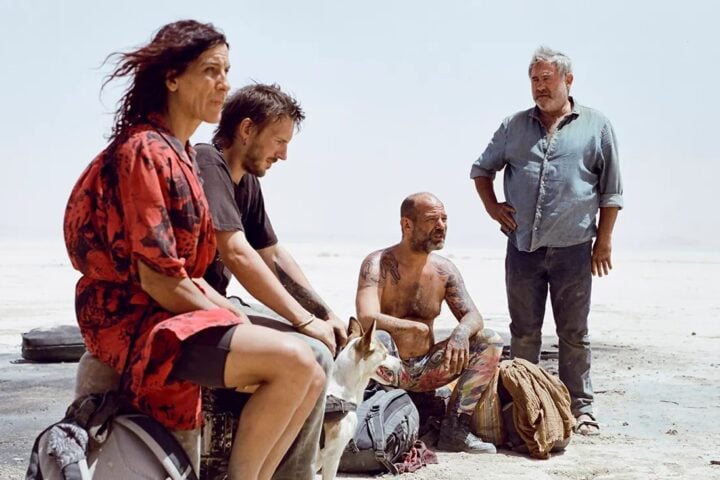
Sirât, per the opening title card of Óliver Laxe’s new film, refers to a bridge “thin as a strand of hair and sharp as a sword” that separates paradise from hell. It’s not hard to spot the analogous representation in the film, a parable-like trial for Sergi López’s beleaguered Luis as he searches for his missing daughter in southern Morocco. Set against the immediate backdrop of a traveling caravan of ravers and the more distant one of a world war flaring up, Luis’s journey takes him to the edge of sanity, as well to a threshold of revelation.
Talking with Laxe and López, it quickly becomes clear that the transformative crucible of Sirât was something undergone not only by the characters on screen. The emotional, existential trip toward a definitive showdown with death itself is such a rattling viewing experience because it mirrors the trials, both intentional and unexpected, that the two artists experienced during the film’s making. López’s soulful performance of a man’s desperate search for definitive answers harmonizes with Laxe’s earnest incorporation of the mythology from his Islamic faith. The resonant result of their efforts offers a cathartic, compelling reckoning with life and death.
I spoke with Laxe and López when they came to present Sirât at the New York Film Festival, where the film had its U.S. premiere. Our conversation covered how elements of religious pilgrimage influenced the film, why Lopez felt he needed to be in a trance to play Luis, and what each of them took away from grappling with the imminence of death.
The film opens with an extended sequence showing the process of setting up speakers for a rave. Why was this the way to open the film?
Óliver Laxe: Raves are a gesture that human beings have been doing for thousands and thousands of years. It’s a ceremony that we were doing to make this catharsis and pray with our bodies. This first sequence is invoking that this is a sacred thing that they are doing.
There’s a shot where one of the ravers watches a TV where people are engaged in ecstatic movement around the Kabbah. Did this element of pilgrimage, albeit more spiritual than religious, enter into how you thought about Luis’s journey?
OL: That was one of the first images of the film—to connect the Quran, the Hajj, and techno. I’m a filmmaker who’s dealing with the sacred and wants to express the mystery of existence. Film has this dimension. It’s a physical adventure, but at the same time, it’s a metaphysical one. Just after these images of this pilgrimage around Mecca, we see an image of Tonin, this guy who doesn’t have a leg, walking in the desert. The connection is really clear.
Sergi López: In the movie, there are a lot of things that were linked to this idea of prayer. Even the music, like the Quran prayer, resonates as a spiritual idea.
OL: It has to resonate. I think in filmmaking and art, you have to find a balance between what you say and what you evoke. I think that, nowadays, cinema and art try to say too many things. It’s too clear. There are no shadows. And I think one of the good things about Sirât is that there is a balance. There is polysemy and ambiguity. There is cinema.
Óliver, you’ve mentioned the importance of having both a physical and metaphysical journey playing alongside each other in Sirât. Are you, Sergi, holding both of those things in your head as well, or is being on set just about playing the immediate moment in front of the characters?
SL: Yeah, it’s enough to play each scene as it happens. At the beginning, I read the screenplay, and I talked a lot with [Óliver]. When we were shooting, we talked a lot about what happened and what the path is that Luis has to take. But for playing, it’s to jump into the scenes and try to forget. Leave your body. My job is to be a little bit in a trance to come off as this character. Don’t think too much, and keep a little bit of freedom.
OL: Something really interesting for me is the memory of the body. I’m studying Gestalt psychotherapy, and we learn how the body can express wounds from the ancestors and from your childhood. He wasn’t connected in a rational way to the wound, but his body was connected. And as an actor, his body was telling him things.
SL: Not consciously, but your body is magic. It knows things and has a memory that you can’t imagine.
What role do dancing and the rave scene play in that journey toward integrating into this community?
SL: It’s not the first time I’ve been in a rave, but I don’t really know this collective and these people who live like this. It was really amazing to me to approach that ignorantly, to go inside, to discover what happens with the music, what happens with the energy, and swim in it.
Óliver, since you were more steeped in the rave scene, how do you make sense of what happens whenever people go into those kinds of environments?
OL: Our societies have ways and ceremonies to make a catharsis with our bodies, to purge our energy. In my case, when I’m going to a rave, I celebrate my wound. You’re really strong and really fragile at the same time on a dance floor, and this is powerful. Your body has a memory when you dance your fragility, your vulnerability, your wounds. It’s healthy. I like to dance, and cinema is about rhythm. I discovered at the end of making this film, I’m a magician too.
Wait, did you say “musician” or “magician”?
OL: [laughs] Both! I discovered that the film is sorcery. Film is inhabited by something. The film is a beast, an animal. It’s not a film about something. It itself is something.
You talked in the past about making films that are more about getting to an essence, rather than delving into a psychology. How do you achieve that effect?
OL: I’m studying psychotherapy, and I’m really interested in psychological types and categories. But when I’m making films, this isn’t [my] language. The way that cinema can capture the soul of a human being and their wound is precious and really particular. That’s why I don’t need to develop my character, because what do you have to develop more than showing their vulnerability through images? There’s something more to their soul. I don’t need to develop much the receipts of their trauma. My images are powerful, and when you can express something through image, you don’t need dialogue much. There’s nothing more special in art and in cinema than to evoke. I don’t want to compare myself to David Lynch, but he was really connected to his unconscious and to the collective unconscious. What he’s talking about is that we feel a lot of things connected with our fears and dreams.
Sergi, does working on this subconscious level require something different from you as an actor compared to roles that are more clearly laid out in the script?
SL: For me, it’s a mystery to play. I have to be able to believe in something to believe I’m Luis. We need faith, and faith is conscious and unconscious at the same time. It’s something that you can feel [bearing down] really hard on you, but it’s not only a physical [experience] or your conscience. It’s something that flows out of you like water. I try to be simple, not think too much, and not stay only in the conscious. For professionals, sometimes we need solutions. I tried not to think about solutions, but trusted my intuition and my body.
As artists, it’s clear that you both operate on faith, and the film deals with spiritual themes. Was it important for the process to be so tied into the product?
OL: Obviously! We put in this film the way we think the mechanism of life is. As I always say, life doesn’t give you what you’re looking for. Life gives you what you need. Making a film is about this too. It’s about dealing with your frustration. Being a human being is about this because, all the time, we’re too attached to what we’re looking for. As a filmmaker or an actor, we want this result, but we’re going another direction sometimes. We think that this is a mistake, but art is about mistakes. And life is about accepting that. Sometimes, as filmmakers, we don’t have the distance to understand that it was perfect like this. Obviously, it’s easy to say here at this table. But when we’re shooting, we’re frustrated.
For me, growing as a filmmaker is to develop my acceptance of life. That’s why we look for limits. That’s why we shot in nature. We don’t shoot in nature because it’s beautiful. Nature has a strong presence in my films because nature is testing you and pushing you to your limits. It’s asking you who you are. It’s taking care of you. And, most of the time, it’s shaking you.
Óliver, you’ve said that cinema is an art of submission. Is Luis saying, “I paced without thinking,” as he walks across the minefield at all a reflection of that?
OL: Yeah, it’s about submission to something bigger than you, not to people. I don’t want to interpret the sequence, but it’s when you give yourself to your intuition.
SL: All humans know that you know, in life, there’s no way to [always] know. You have to walk, and you cannot anticipate what will happen after. You have to accept the present. I think, secretly, we know that you have to cross the desert in life, and mines can explode. You cannot live thinking that they will explode. If you’re afraid of that, you don’t walk. You have to walk.
OL: Life is pushing us to jump. All the time, it’s pushing us to our limit and asking us, “Who are you?” When you don’t do the work, the challenge is tougher and tougher. Luis didn’t do the work at the time. He’s probably 55, 60 years old, and life is slapping him in the face because he didn’t do the work already. But, possibly, what happened is mercy for him.
The word sirât refers to a path that Óliver has referred to as a “death before death.” To me, though, this feels just as much about finding life by acknowledging the inevitability of death. Have you felt the experience of making this movie and going on this journey impact you beyond the production?
OL: I was on a plane three weeks ago that was having a lot of turbulence. I was afraid, [and so were] the people working on the plane, but at some point, I was like, “Come on, man, you are the filmmaker of Sirât! You cannot be afraid of the plane.” And it helped me! I was like, “Yeah, okay, if I have to die now, it’s okay.” From the perspective that I want to have, you die when you have to die. The question is: How do we die? How do we cross the minefield that is life? Are we going to cross with dignity, with our values, like he does? [The characters in] Sirât talk about these grandiose deaths. One dies dancing, and the other dies helping another person. For me, as a human being, it’s important to understand that life is a test to die with dignity.
SL: The movie talks about that. He proposes a reflection and meditation on this. That’s why the movie shocked and hit people, and I think that film changed something in me too. I did an interview, and the title of the interview was “I Can Die Tomorrow.” I asked, “I said that?!” We talked about the movie, but I was also talking about my life. It’s a grand step of knowledge to think about death, because when you think about it, you’re not so afraid of it.
OL: I felt myself growing while making this film for several reasons, and Sergi, I feel that you also grew. The way you speak about the film, the way you speak about yourself, the way you’re looking inside [yourself], I think it’s powerful.
SL: But I think that what’s powerful is the movie. For the public and for all the people, the movie forces you to look inside.
Since 2001, we've brought you uncompromising, candid takes on the world of film, music, television, video games, theater, and more. Independently owned and operated publications like Slant have been hit hard in recent years, but we’re committed to keeping our content free and accessible—meaning no paywalls or fees.
If you like what we do, please consider subscribing to our Patreon or making a donation.