
Like he and his brother Benny did at the start of Uncut Gems, Josh Safdie pushes his intimate aesthetic to literal extremes by taking the camera inside a character’s innermost organs during Mary Supreme’s opening credits. As an egg inside a uterus newly fertilized by sperm from Marty Mouser (Timothée Chalamet) fades visually into a ping-pong ball in the middle of a match play, the film establishes a parallel between the titular striver’s carnal impulses and his competitive drive. Both spherical objects represent the promise of a future toward which Marty is careening—provided he can ever get out of his own way.
Written on this ping-pong ball is the title of the film but also a second phrase that could easily function as its subtitle: “Made in America.” Safdie and co-writer Ronald Bronstein, riffing on the life of table tennis champion Marty Reisman, interrogate that distinctly American myth of upward mobility. Though rooted in the vividly drawn specifics of his own cascading struggles, Marty Mouser’s quest for greatness reveals the messy mechanisms of accumulating prestige and power at the pinnacle of the United States’s global dominance.
Marty’s ambitions are squarely in line with a classic rags-to-riches tale. While he might work in a shoe store in the Lower East Side of Manhattan to make ends meet, Marty sees his real path to success through his prodigious ping-pong skills. The hot-headed, motor-mouthed twentysomething hopes to ride a wave of appreciation for the sport and leave behind a life of tenements and retail drudgery. He’s not shy about wielding the soft cultural power of his country to get a leg up on the competition, pleading for preferential treatment from league officials in the name of what an American champion would do for the game.
Marty feels entitled to be cradled by the U.S.’s post-war prosperity, but he has to find alternate routes toward recognition. As a Jewish-American at a time of the ethnicity’s tentative assimilation into whiteness, his identity is rooted in being history’s perpetual underdog during a peak period of American hegemony. He can boast that being on top of the table tennis world marks “the ultimate product of Hitler’s defeat,” but without more support from entrenched elites, all that achievement gets him is being the halftime act for the Harlem Globetrotters.
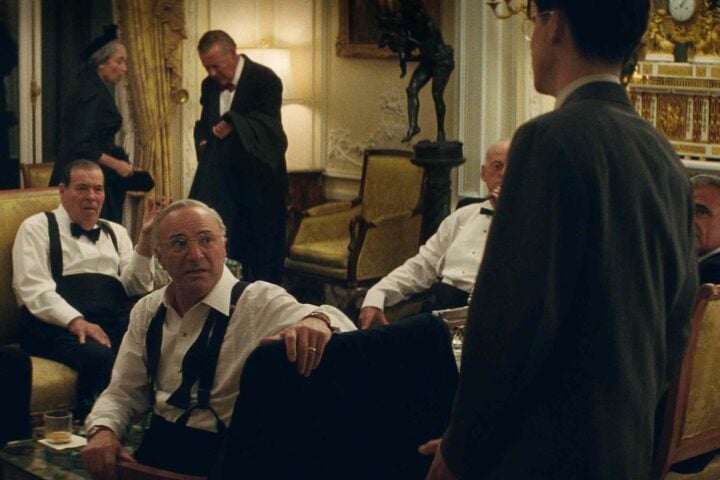
To reap the full benefits of his pioneering position, Marty recognizes the need for establishment validation. A chance hotel encounter during a tournament in London brings him into contact with a WASP-y Upper East Side couple. He woos Kay Stone (Gwyneth Paltrow) with his boyish charm, preying on her vulnerabilities as an actress who sold out her career to become a socialite. Meanwhile, Marty is undaunted in schmoozing her husband, Milton Rockwell (Kevin O’Leary), to help bankroll table tennis’s worldwide expansion through his pen manufacturing empire.
O’Leary, best known to many as “Mr. Wonderful” on CNBC’s competition show Shark Tank, is a genius stroke of casting for Marty Supreme. The role provides him yet another on-screen persona where he’s tasked with sorting out the true entrepreneurs from everyday egotists with hair-brained ideas. Safdie and Bronstein are maximalist thinkers, meaning that it isn’t enough for them to link past and present eras of American business with its gatekeepers and disruptors. They obliterate temporal boundaries, making for a period film that portrays one era in great specificity while also capturing how its legacy echoes across time.
Marty Supreme rapturously reprises a siren song that transcends any single American era, beckoning hustlers to heed its call. This quality is most obviously evoked by Daniel Lopatin’s pulse-pounding synth-pop score and the soundtrack’s anachronistic new wave needle-drops. But it’s also evident in the way Safdie lets off-screen personas bleed into the characters on screen, especially from Chalamet and how his public pursuit of greatness mirrors Marty’s own.

Chalamet and Safdie are both highly attuned to this frequency as born-and-bred New Yorkers, a heritage they proudly proclaim and put to full effect in the film. Marty Supreme is populated by a plethora of local figures and native sons, who all give the film an indisputable texture and personality. This commitment to filling out the frame with other homegrown talent extends to up-and-coming actors (Fred Hechinger and Levon Hawke), filmmaking fixtures (Abel Ferrara), and even a grocery mogul with no previous acting experience (John Catsimatidis).
Safdie, like many a great New York director before him, treats his hometown as a larger-than-life backdrop against which an extraordinary story realistically unfolds. Just as the Big Apple represents the U.S. at its most exemplary and excessive, Marty is an embodiment of this epicenter of a nation’s activity. Chalamet lives, breathes, and even bleeds this New York energy as Marty’s silver tongue and swinging dick land him in a series of predicaments that ultimately humble him. As Marty sets out to prove his mettle through circumstances that would grind down a less resilient person, the film recognizes that the difference between a dream and a delusion is often the resolve of an individual to bend the world to their reality.
Throughout this thrill ride, across settings where it feels that cosmic ironies are at work, Safdie and Bronstein never take their eye off the ball of their story’s thematic resonance. Their film is far from a lazy lionization of Marty, nor do they ever simplify the resolution of any event to a force like talent or luck. Marty Supreme offers a clear-eyed look at the hollow promise of American self-reliance. They see through the terminology used to sell outsiders on social advancement—purpose, obligation, sacrifice—as tools that reinforce the stranglehold of the rich.
Marty’s insistence on roping others into his improvised solutions to his problems—especially the equally crafty Rachel (Odessa A’Zion), a lifelong friend carrying his child—further highlights the surprising alliances required to keep the flame of achievement flickering. The challenges in translating his skills into status expose the gaps in triumphalist narratives around economically disadvantaged groups using sports as a ladder up to power. In this instance of pulling oneself up by their bootstraps, Marty’s still cobbling together the boots.
But Safdie and Bronstein also understand the sports movie genre’s inherent sympathies with the drive to achieve. They cut against this inclination at each step by never sanding down the edges of their protagonist. Marty can be both slimy in his approach and compulsive in his behavior, which complicates an audience’s relationship to cheering on the protagonist.
In totality, though, Marty is more than just a monument to hubris at his worst and heroism at his best. Chalamet’s performance renders him as achingly human as the acne scars dotting his face. The actor matches Safdie’s filmmaking intensity, translating his bone-deep physical and psychological connection to Marty into a gritty show of live-wire emotionality.
What emerges from Chalamet is a revelatory, twitchy responsivity that keeps Marty Supreme anchored in the immediacy of Marty’s anxiety. The character’s big win is hardly even cause for jubilation. After consistently teetering on the brink of oblivion, the cost of getting what he desires leaves him with no gas left in the proverbial tank. The victory must be of a pyrrhic nature since it’s still a Safdie film, but it’s a victory all the same.
Since 2001, we've brought you uncompromising, candid takes on the world of film, music, television, video games, theater, and more. Independently owned and operated publications like Slant have been hit hard in recent years, but we’re committed to keeping our content free and accessible—meaning no paywalls or fees.
If you like what we do, please consider subscribing to our Patreon or making a donation.