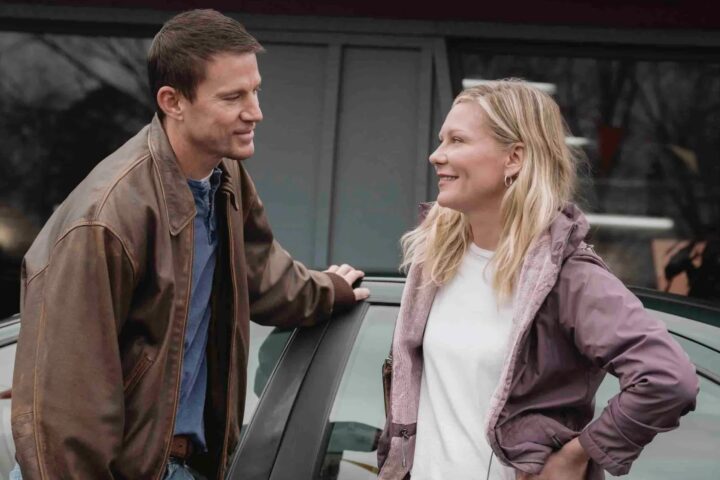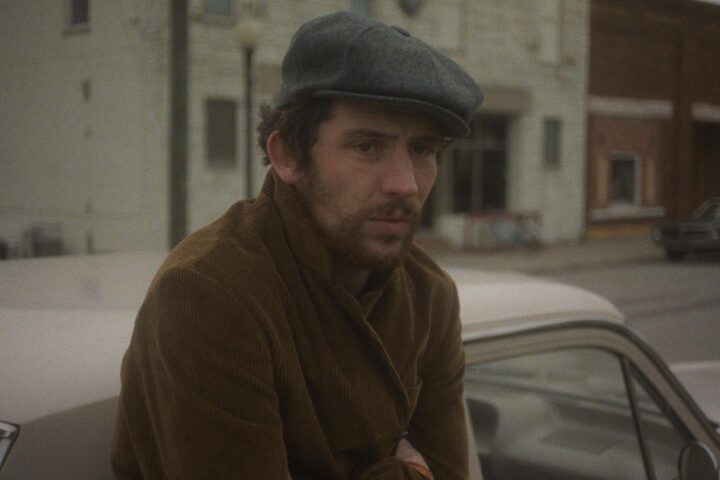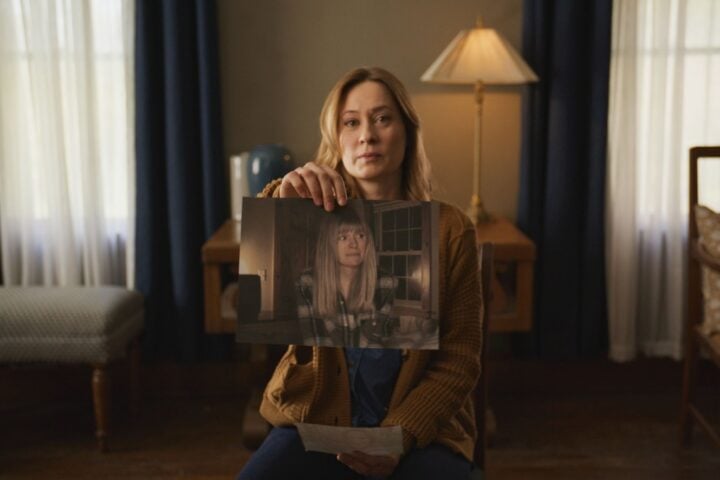
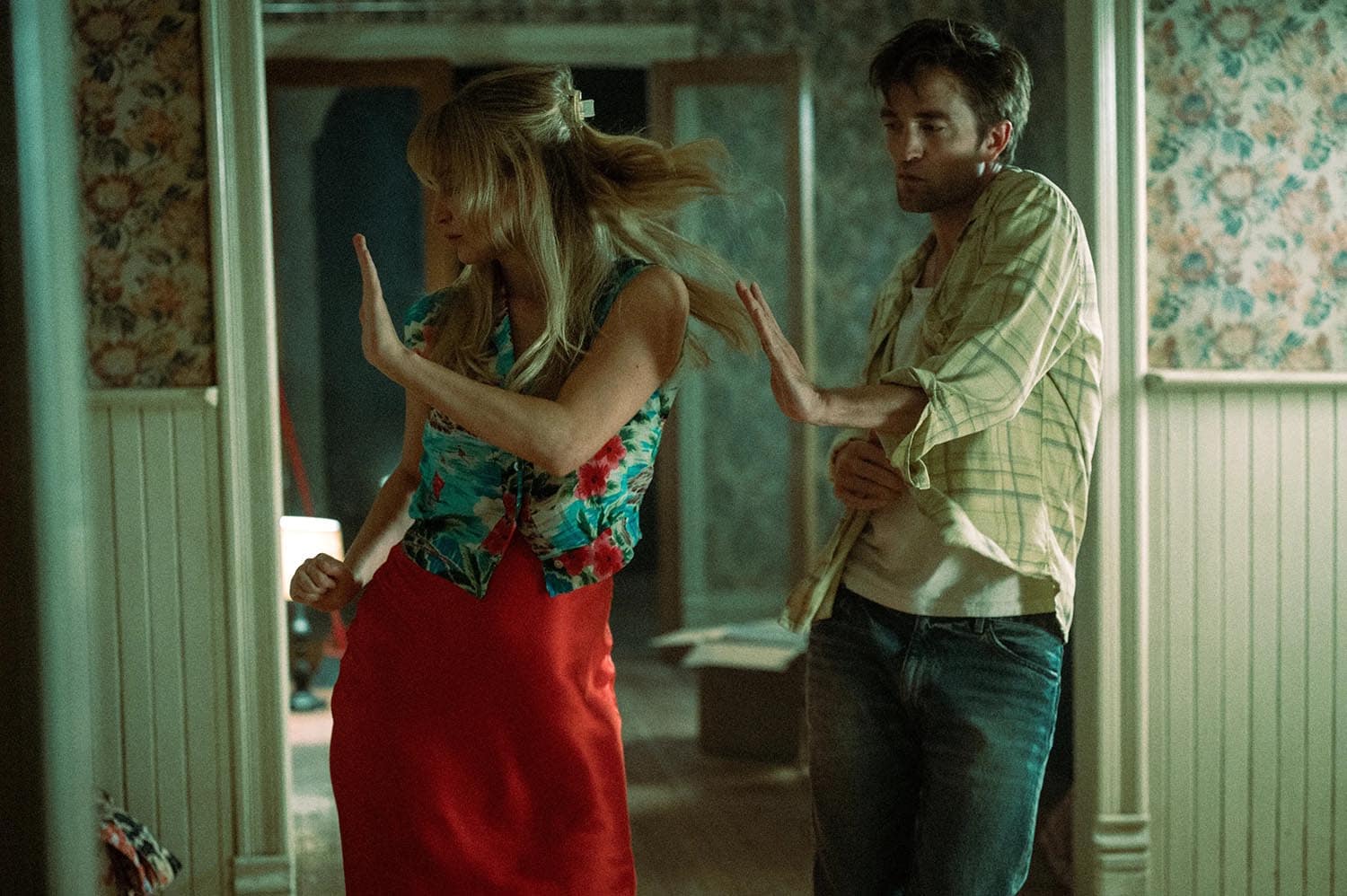
Cinematographer Seamus McGarvey captures four distinct planes of action in the opening shot of Lynne Ramsay’s Die My Love. The camera stays fixed in the kitchen as a young couple, Grace (Jennifer Lawrence) and Jackson (Robert Pattinson), pull up outside a dilapidated country house. As they wander through the rooms, the pair assesses whether this heirloom home with a fraught history should be the place where they establish their own roots.
That staggering opening shot also represents a kind of calm before the storm, setting the table for just how many visions Ramsay’s film can simultaneously hold. Die My Love, the Scottish director’s fifth feature, proves to be her most sprawling and sensational canvas to date. Ramsay expressionistically charts Grace’s postpartum journey, pulling out all the aesthetic stops to vividly render the experience in all its physical and psychological dimensions.
Throughout, Ramsay unleashes her most galaxy-brained concepts with a full-bodied commitment that should be the envy of filmmakers with similar ambitions, and to the point that the film often feels thrillingly free-associative. Early on, Grace is frustrated at not being able to find the inspiration to resume her writing. The camera captures the black ink drops on a page as they mix with the milky white lactation falling from Grace’s breasts above, only to then fade into a portrait of the cosmos as Jackson observes the stars from a telescope on their porch.
Less assured films would crumble under the weight of concretizing abstractions or literalizing metaphors. But the subject matter of Die My Love makes it dispositionally aligned with the maximalist energy that Ramsay brings to bear. To dismantle the mythologies of maternity, her tool of choice is the sledgehammer rather than the scalpel. It’s a film designed to rattle the viewer to the same extent as the experiences depicted here rattle Grace and Jackson.
Interspersed between Die My Love’s patchwork of scenes following the couple’s adjustment to parenthood in their new rural Montana home are allegorical images of the natural world. A violent energy is unleashed from realms as they collide, beginning first with juxtapositions suggesting a shared savagery. And as the transformations of childbirth and caretaking weigh on Grace and Jackson, they begin to personify the chaos of the wildlife around them.

Ramsay requires nothing short of surrender from her leads to achieve this effect, stripping away any trace of actorly vanity from Lawrence and Pattinson as they’re pushed toward extremities of expression. With feral ferocity, they prowl like lions, bark like dogs, and clamber over each other like monkeys. Parenthood spurs Grace and Jackson’s regression into a primal mental state, with the care of a newborn retraining their instincts to focus on the basest survival needs.
Holding his own opposite a formidable Lawrence as her character quickly descends into all-consuming psychosis, Pattinson delivers a deeply embodied performance. Ramsay makes expert use of his live-wire reactivity and fearless abandon to provide an uncommonly raw look at how becoming a father also alters one’s physical experience of the world, even if not as drastically as it does for a mother after giving birth. For this, Die My Love isn’t just about postpartum depression but also about how madness devastates a marriage and a family.
The film comes to resemble the family house itself, storing inexpressible truths in its structure as it connects generations. Die My Love benefits from the presence of Jackson’s mother, Pam (Sissy Spacek), as she navigates a parallel track of transformation with her daughter-in-law. She grieves the loss of her husband (Nick Nolte) as Grace welcomes life into the world. Ramsay posits widowhood and motherhood as equal and opposite journeys, both prompting existential crises of feeling incomplete without someone once held so tight to the body.
Yet the film’s center of gravity is Lawrence. The actress is quite literally a force of nature, a connection Ramsay crystallizes by equating her character at one point to a forest fire. Lawrence’s performance externalizes all the impossible contradictions of becoming a mother. She squares the circle of a character who struggles to be erotic, empathetic, and energetic as she feels estranged from the person she was before giving birth. Even in the most dialed-up moments of domestic discord, Lawrence grounds the film in Grace’s hardscrabble, heartfelt struggle to maintain her tenuous connection to the humanity she once knew.
Since 2001, we've brought you uncompromising, candid takes on the world of film, music, television, video games, theater, and more. Independently owned and operated publications like Slant have been hit hard in recent years, but we’re committed to keeping our content free and accessible—meaning no paywalls or fees.
If you like what we do, please consider subscribing to our Patreon or making a donation.