
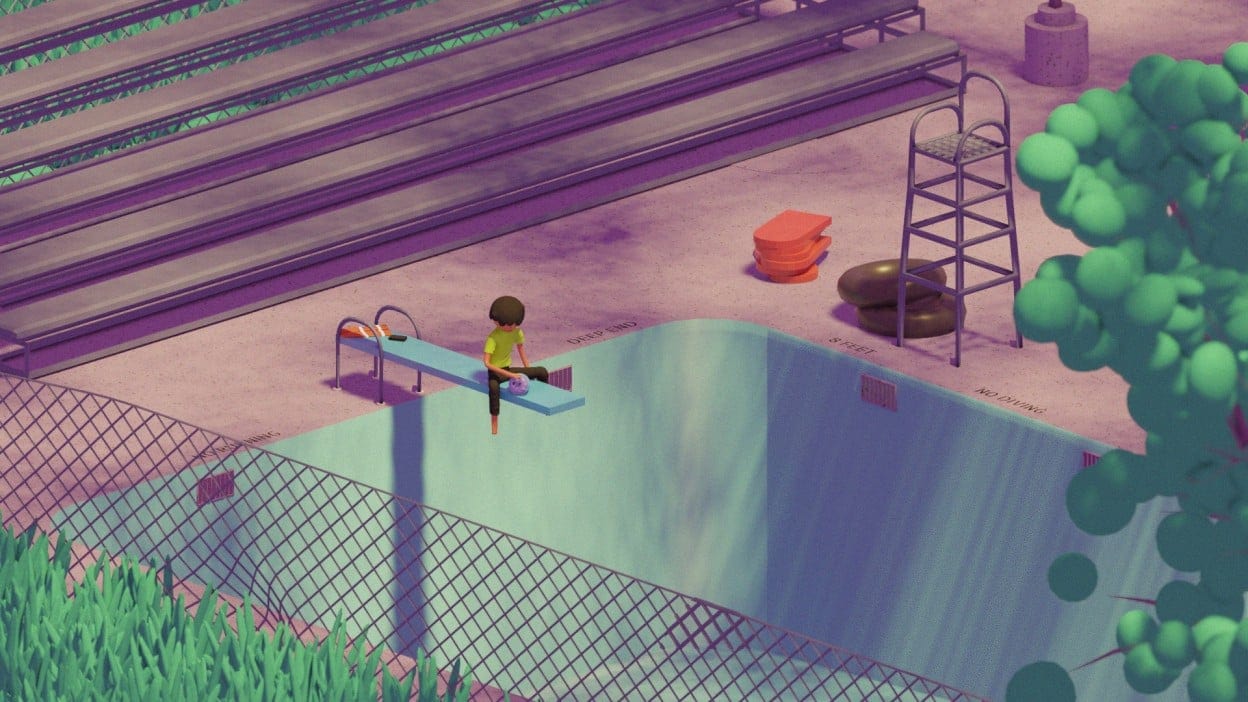
Julian Glander is a 3D artist whose work ranges from children’s books to video games, and the influence of the former on his feature-length directorial debut, Boys Go to Jupiter, is especially evident in the film’s isometric vision of the world. In the right light, his simple, rounded characters could pass for clay figures. Glander isn’t exactly emulating stop-motion, but the characters’ minute movements evoke it all the same, bringing a hand-crafted quality to a medium that’s typically viewed as impersonal. Every cut to a distant camera perspective asks us to ruminate over every detail that’s gone into composing the film’s scenes.
At a gentle, ambling pace that’s punctuated by dreamy musical numbers, Boys Go to Jupiter follows Billy 5000 (Jack Corbett), a high school dropout and “human calculator.” Billy, who’s growing apart from his friends, lives out of his sister’s garage and is determined to make $5,000 by gaming the food delivery app Grubster, one mandated “have a grubby day” farewell at a time. The explanation of that process—which involves multiple currency transfers—is one of several times that Glander fills the screen with an explanatory graph, computer interface, or book illustration. Combined with its diorama perspective of the world, the film carves out an orderly yet intimate style that suggests Earthbound by way of Wes Anderson.
Glander drops Boys Go to Jupiter’s peculiarities on us gradually: a dinosaur-themed golf course, a sentient slug-like creature, and a genetically altered lemon that could save the world. A handful of bees float harmlessly around a girl (Miya Folick) who goes by Rozebud rather than her given name of Rosario Dolphin. Eager to get caught up in the hustle and grind of the gig economy, Billy is an aberration among easygoing characters in a world that feels like it’s in stasis: Florida’s winter, after all, differs little from its summer, as evidenced by one lanky hooligan, Freckles (Grace Kuhlenschmidt), still running around shirtless.
Boys Go to Jupiter is driven less by plot than by the atmosphere that Glander summons, and its pacing occasionally sags from a few too many tangents. (The conclusion is more random than thematically satisfying.) But it’s quite an atmosphere, with Glander powerfully channeling the ennui of his characters with images of everything from vacant parking lots to empty swimming pools. The video game-esque camera angles are particularly evocative, recalling a medium where the on-screen avatar is at the mercy of an outside force, and in the process reflecting how much of Billy’s life, despite his best efforts, remains beyond his control.
Since 2001, we've brought you uncompromising, candid takes on the world of film, music, television, video games, theater, and more. Independently owned and operated publications like Slant have been hit hard in recent years, but we’re committed to keeping our content free and accessible—meaning no paywalls or fees.
If you like what we do, please consider subscribing to our Patreon or making a donation.