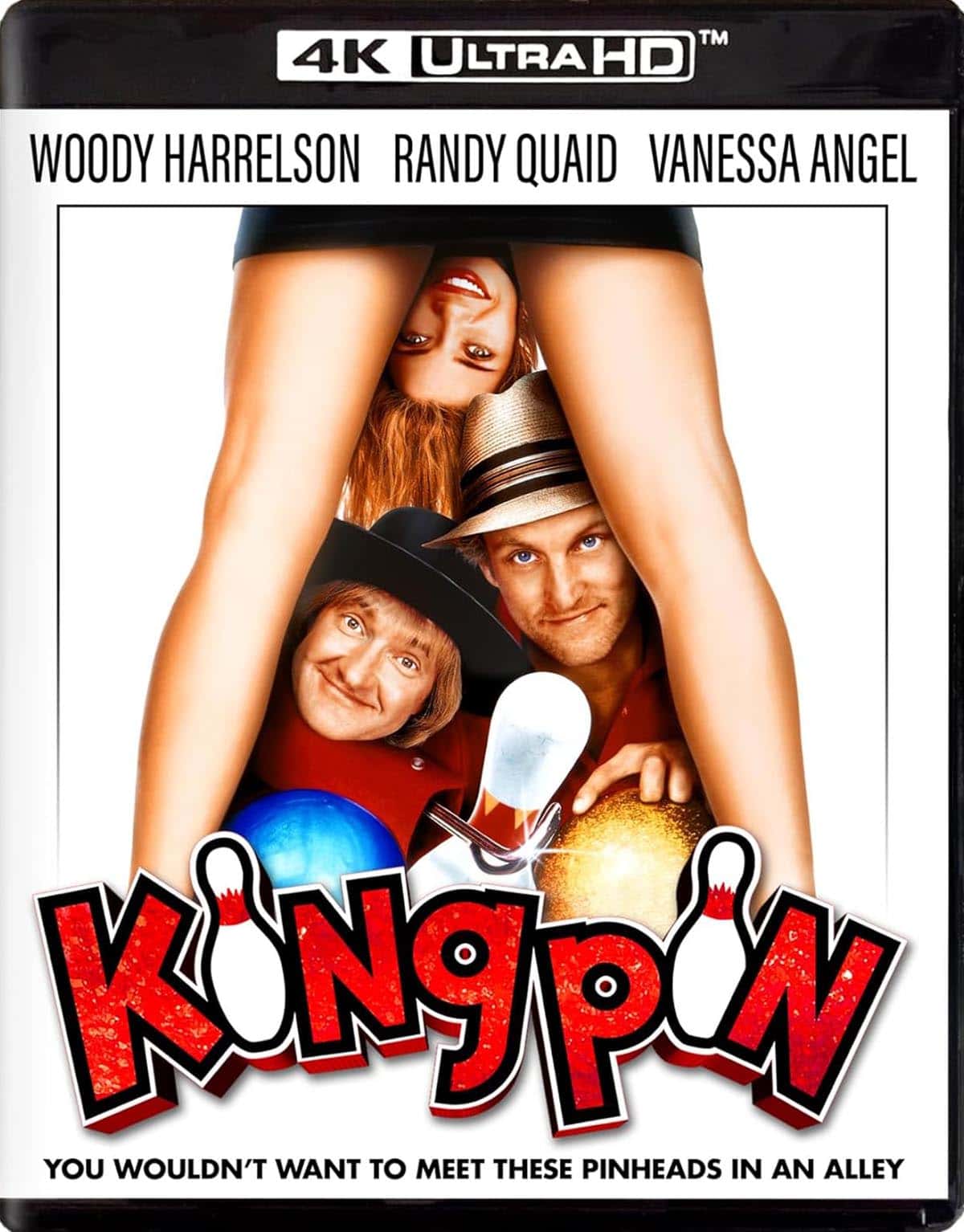
 The pleasures of Kingpin are multitudinous, but only if one appreciates the lowbrow sensibilities of Bobby and Peter Farrelly as a high-water mark of 1990s American studio comedies. Consider a scene in which Roy (Woody Harrelson), an alcoholic former bowler with a hook for a hand who’s passing as Amish in order to lure the young Anabaptist Ishmael (a 45-year-old Randy Quaid) toward the modern bowling circuit for a big payday, accidentally drinks bull semen. If Voltaire’s Candide introduces its naïve hero to humankind’s degradation of self and other, the Farrelly brothers’ live-action cartoon functions much the same way, albeit through the prism of mid-’90s advertising, sports culture, and adolescent male desire.
One of the objects of such desire is Claudia (Vanessa Angel), the voluptuous girlfriend of a wealthy bowling shark named Stanley (Rob Moran). Emblematic of the film’s devotion to cartoon logic, she runs off with Roy and Ishmael after Stanley smacks her around. Similar to the character played by Lauren Holly in the Farrellys’ Dumb and Dumber, in which her briefcase sets the entire plot in motion, Claudia becomes both a reason for Roy’s redemption and a means to help get him and Ishmael to Reno for a million-dollar prize bowling tournament.
In one of several montages from the film, Claudia uses her body to distract Roy and Ishmael’s competitors and make them lose. The punchline to this sequence involves bringing in a sheep to then distract some rural bowlers who are unfazed by Claudia’s tactics. In the Farrellys’ hands, even the suggestion of bestiality has a strangely soft edge to it.
Far less desirable is Mrs. Dumars (Lin Shaye), Roy’s landlord, who he finds so grotesque that he vomits repeatedly after they have off-screen sex as payment for his rent. If the implication of Roy’s nausea wasn’t clear enough, Mrs. Dumars gives him the universal sign for cunnilingus on her way out the door, which Roy will hallucinate seeing a couple more times throughout the film as a nearly ghoulish reminder that he can’t go back from whence he came.
These callbacks are less mean-spirited than playful, more grist for the Farrellys’ wacky mill. Comparable to something like The Naked Gun, the film hangs about as many gags on its loose plotting as it can, yet the brothers’ work seldom dips into outright spoof, even when briefly paraphrasing scenes from such films as Witness and The Seven Year Itch.
The Farrellys’ style of comedy is at its best when it gives space to the comedic performers to meld their comedic sensibilities with the filmmakers’ own. Roy’s rival, Big Ern McCracken (Bill Murray), is essentially an extension of Murray’s well-known comedic persona as a walking wisecrack, and as the Farrellys have explained, they basically threw out Barry Fanaro and Mort Nathan’s script whenever Murray walked on set and let him improvise.
When Big Ern shows up early in the film, it’s 1979, and he’s sporting a short afro, hitting on women in diners, and eventually leaving Roy for dead after a bowling hustle goes sideways. Fifteen years later the man is still a womanizing prick, but now he’s rocking a wild combover (also Murray’s idea according to the filmmakers) that becomes the main visual joke during the inevitable final round of the tournament between him and Roy. Time passes, but as Big Ern shimmies and writhes around in apathy of his past and present abhorrent behavior right in Roy’s face, only the realities of male-pattern baldness have set in.
Image/Sound
Kino Lorber’s 4K of Kingpin, graded in Dolby Vision HDR, is a blemish-free scan of the 35mm original camera negative. Everything from the sunny exteriors around the Amish farm to the quaint, colorful interiors of the bowling alleys is on pristine display. The DTS-HD MA 5.1 surround mix gives primacy to the electric soundtrack choices, and tracks like the Trammps’s “Disco Inferno” will especially give your system a workout. Dialogue is clearly presented and mixed well with the music. There’s also an alternative 2.0 stereo mix.
Extras
In a new commentary track, critics Bryan Reesman and Max Evry offer up a plethora of behind-the-scenes details, including alternative casting possibilities and how the Farrellys worked to change the script to suit their needs. The archival commentary track by the brother filmmakers, recorded a few years after the film’s original release, also provides some insight into their directorial process, allowing Bill Murray to ad-lib most of his lines. There’s also a featurette from 2014 with the Farrellys looking back at the film in between bowling a few frames of their own. Rounding out the extras are a handful of theatrical trailers and TV spots.
Overall
As Big Ern McCracken might say, this excellent new 4K release of Kingpin from Kino Lorber rolls into town on a gravy train with biscuit wheels.
Since 2001, we've brought you uncompromising, candid takes on the world of film, music, television, video games, theater, and more. Independently owned and operated publications like Slant have been hit hard in recent years, but we’re committed to keeping our content free and accessible—meaning no paywalls or fees.
If you like what we do, please consider subscribing to our Patreon or making a donation.