The Latin phrase memento mori, meaning “remember you must die,” looms over Danny Boyle’s 28 Years Later and, in hindsight, Alex Garland’s work as a screenwriter in toto. Because what unites such disparate films as 2018’s Annihilation and 2022’s Men, and meditations on the hell of armed conflict as different in conception as 2024’s Civil War and this year’s Warfare, if not the all-consuming specter of death, the manner in which we choose to face our own oblivion, and how we make meaning of the deaths of others?
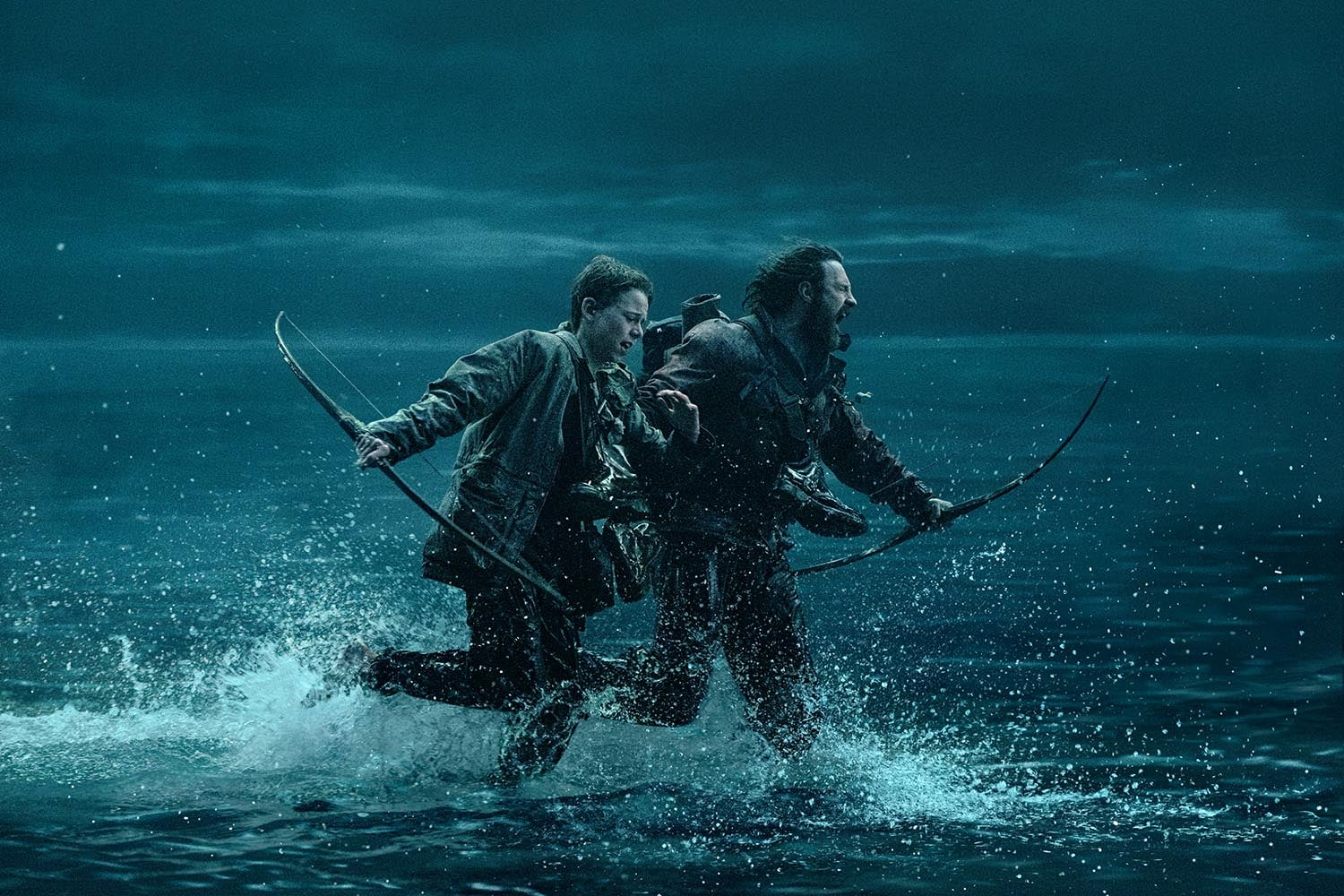
28 Years Later, set nearly three decades after the Rage virus all but snuffed out life in Great Britain, centers on a small group of survivors living on Lindisfarne (also known as Holy Island), a tidal island off the northeast coast of England connected to the mainland by a causeway. When 12-year-old Spike (Alfie Williams) accompanies his father, Jamie (Aaron Taylor Johnson), to the mainland for the first time, he has his first brush with the infected and learns to kill.
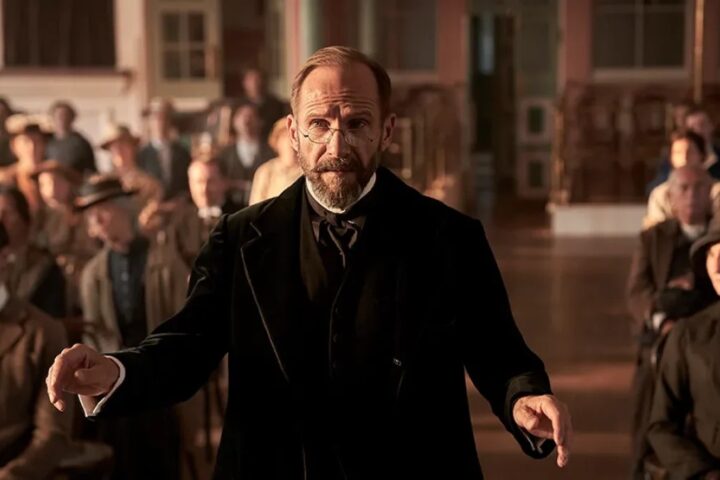
Upon returning home triumphant from his first hunt, and more curious about the outside world, Spike learns things about the crazed Dr. Ian Kelson (Ralph Fiennes), a former physician whose fires can be spotted burning in the distance, that change his relationship to his world. Against his father’s wishes, Spike ventures forth from the island with his mother, Isla (Jodie Comer), in an effort to seek out Kelson and find a cure for her mysterious sickness.
28 Years Later harnesses the technological advances of smartphones to wildly inventive effect. Notably, Anthony Dod Mantle’s cinematography doesn’t try to obscure or degrade the image to make it fall in line with the look of the original film, choosing to embrace the progress consumer-grade digital video has made. Reflecting our current era, where our first glimpses of atrocities worlds away seem to arrive via smartphone footage, 28 Years Later feels pointedly “now,” with a digital clarity that could only have been dreamed of in 2002.
As cramped and citybound as 28 Days Later and its sequel felt, 28 Years Later is all wide-open vistas and rolling hills. The film finds oppression not in tight urban spaces, bombed-out apartment blocks, or secluded country manors, but in the overwhelming power of a nature that’s reclaimed what humans once brought to heel. Boyle and Mantle set the verdant forests and imposing hills of Northern England and the Scottish Highlands apart from Spike’s grim and foreboding village, the unbound beauty of the wilds drawing the young man despite whatever dangers the verdant woodlands and broken abbeys that dot the land might hold.
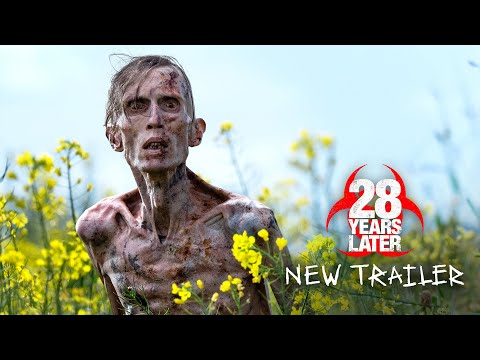
As for the infected, the classic runners of the first two films roam the lands naked, their clothes having rotted off their bodies. Elsewhere, a roly-poly variety of once-humans that wriggle along the ground show us that the infected have also branched off into evolutionary subcategories.
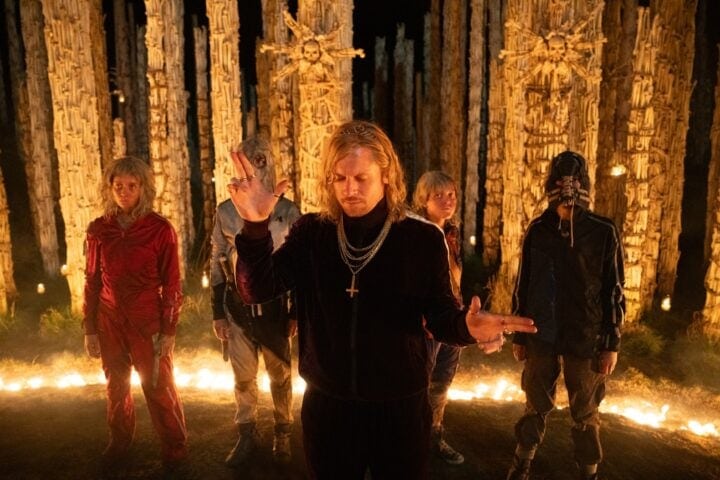
The divide between us and them is underscored through the Holy Islanders’ celebratory attitude toward killing. Their survivalist, tribal ways are literally flagged by a Saint George’s Cross flying above their village, a symbol from the Late Middle Ages associated with early Christian martyr Saint George that was adopted as the flag of England and to this day is a symbol of nationalism. In typical Garland fashion, 28 Years Later is in constant conversation about violence and the propensity the supposed “evolved” have for committing it.
Jamie, a tough scavenger who seems to take great pleasure in killing, tells his trembling young son at one point, “The more you kill, the easier it gets,” and assures him that the infected have no mind and no soul. As in 28 Days Later, when Christopher Eccleston’s Major Henry West is shown to have chained up a Black man to see how long it takes the infected to starve to death, dehumanization is the point—the idiomatic pebble in the film’s shoe.
The crass love of violence Spike brushes up against in his own people is contrasted with the poetic tenderness of Dr. Kelson, who presents a different way to engage with death, eternity, and what it means to give all living things dignity in a world of endless suffering. The personal crisis this presents for our young protagonist is what gives the film dramatic liftoff.
Garland’s conception of the future, perceptively, looks back to humankind’s primeval past. Outside the walls of Spike’s enclave, the world has largely been fucked back to the Stone Age, and the film has death on its mind not merely as a constant reality and danger facing the characters, but also how we conceive of death and treat it as a social event.
One of the primary things that sets us apart from the animal kingdom is our reverence for the dead, our ingrained need for ritual and meaning-making in the face of our own mortality, and respect for those who’ve gone before us. For Garland, it seems, how we die has a lot to say about how we live, and though 28 Years Later leaves us at a crossroads that’s not your typical action-movie ending, it’s more importantly an emotional climax that elevates the material and makes it feel like something much more substantial than the first chapter in a planned trilogy.
Since 2001, we've brought you uncompromising, candid takes on the world of film, music, television, video games, theater, and more. Independently owned and operated publications like Slant have been hit hard in recent years, but we’re committed to keeping our content free and accessible—meaning no paywalls or fees.
If you like what we do, please consider subscribing to our Patreon or making a donation.