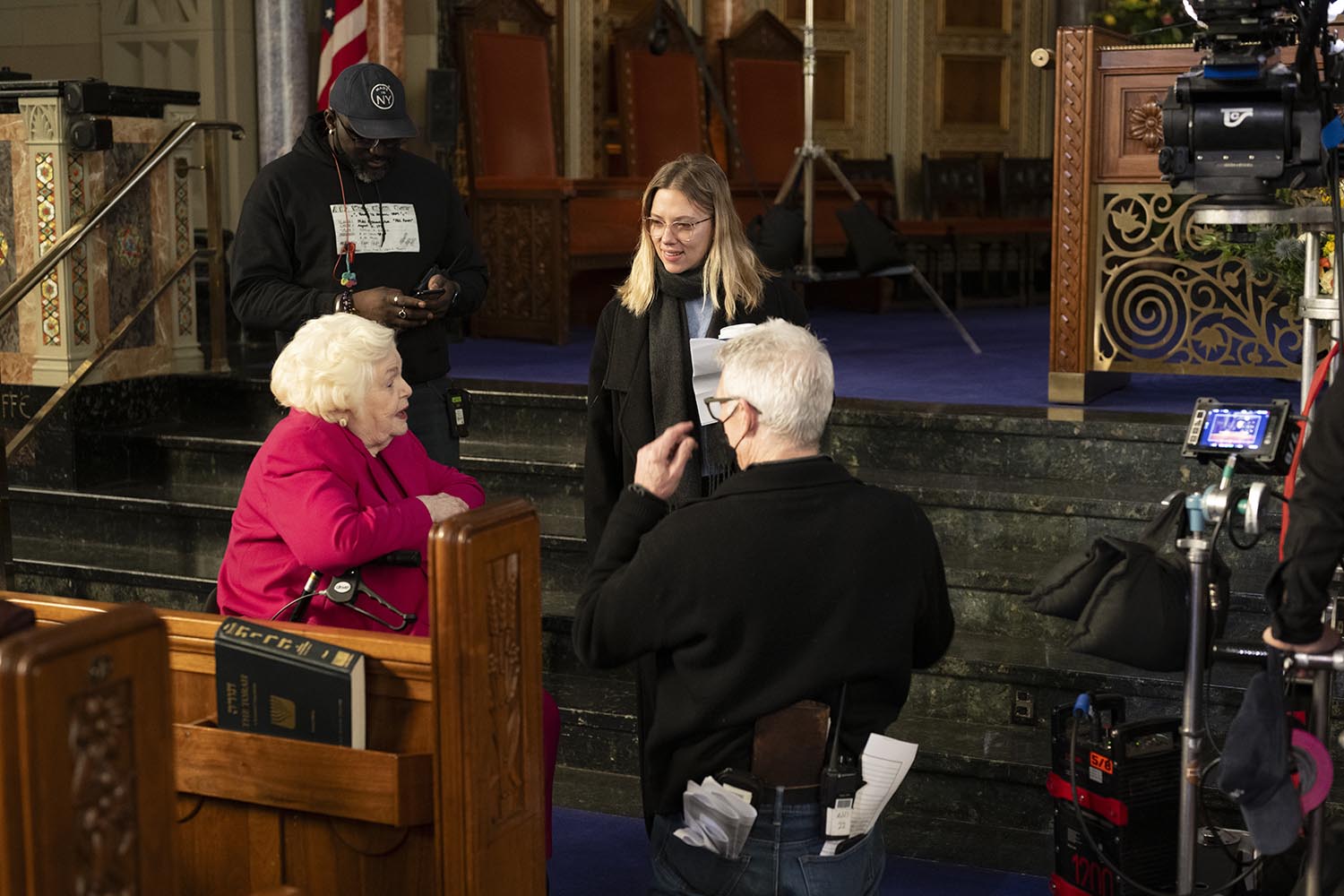
Scarlett Johansson’s directorial debut, Eleanor the Great, is about a woman who builds a persona around a lie a movie centered on a lie. It’s a rather big lie based around a friend’s Holocaust experiences that, divorced from all other context, would be an express-lane shortcut to getting cancelled forever. But there’s context for the lie.
Specifically, it’s the trauma caused by the death of a longtime friend whose story will never be told otherwise, of having to uproot to a new home, and the sheer loneliness of having to confront one’s own failures as a friend and parent. That context doesn’t excuse June Squibb’s Eleanor from the fallout of her actions, but it does justify the grace shown by those around her.
That grace is what drives the film, and one of the things that makes it stand out in a field of bigger films with less on their minds, and much smaller hearts. And it’s with that in mind that I sat down with both Johannson and Squibb for a brief chat to talk about that sense of humanity.
Scarlett, this is a film that encompasses a wide range of womens’ experiences. What was your biggest lesson learned from having to portray all that on screen?
Scarlett Johansson: The intergenerational relationship between these women is one of the themes that was interesting, [as was] the challenge of directing this range of actors. Jessica Hecht is just such a different actor than June, than Chiwetel [Ejiofor]—they all had different methods of communicating, and the discovery process is different. But the thing that [I had to learn] was how to give the actors the specific answers they needed to help them to make new discoveries, and understand the importance of listening to their needs as a director.
June, you’ve had this fascinating string of unique leading roles lately—to the point that I’ve seen someone say that we’re lucky to be living in a “Squibbisance”—which is remarkable. At this point in your career, what are you looking for in a role?
June Squibb: [laughs] Well, above all, I want to read a good script, I want it to be real, and Eleanor was that. She gave me everything. She wasn’t a nice lady half the time. And this is great! These are things you think, “Wow, I do want to play that, I understand that scene, I see where she’s going.” This is what I’ve always looked for, and this script had it in aces, this woman who had so many parts of her emotional life showing. She wasn’t afraid of being herself with anyone.
From both of your perspectives, what are your takes on the forgiveness that’s afforded to Eleanor by the end?
Scarlett: I would hope that the audience has compassion and empathy for what Eleanor’s experiencing, and understands the urgency that she feels to share her friend’s story. Of course it’s not done in the way it’s supposed to be, and I think that’s something you have to, as an audience, grapple with. I’m certainly not trying to erase that, but [Eleanor] owns it, and explains herself. In my own life, I think forgiveness is such an important part of my growth as a person as I’ve gotten older. I hope I continue to have more compassion and empathy for others as I experience life. It’s just hard to hold onto resentment and blame. It stops movement and growth and change. June, on the other hand, isn’t a forgiving person. [laughs]
June: [laughs] It’s true! But I also feel like if you don’t forgive, you lose so much. You lose circumstances, things you want to do again. And you know, I may not want to do that, I’m mad at them. But it is silly. You lose too much.
Since 2001, we've brought you uncompromising, candid takes on the world of film, music, television, video games, theater, and more. Independently owned and operated publications like Slant have been hit hard in recent years, but we’re committed to keeping our content free and accessible—meaning no paywalls or fees.
If you like what we do, please consider subscribing to our Patreon or making a donation.