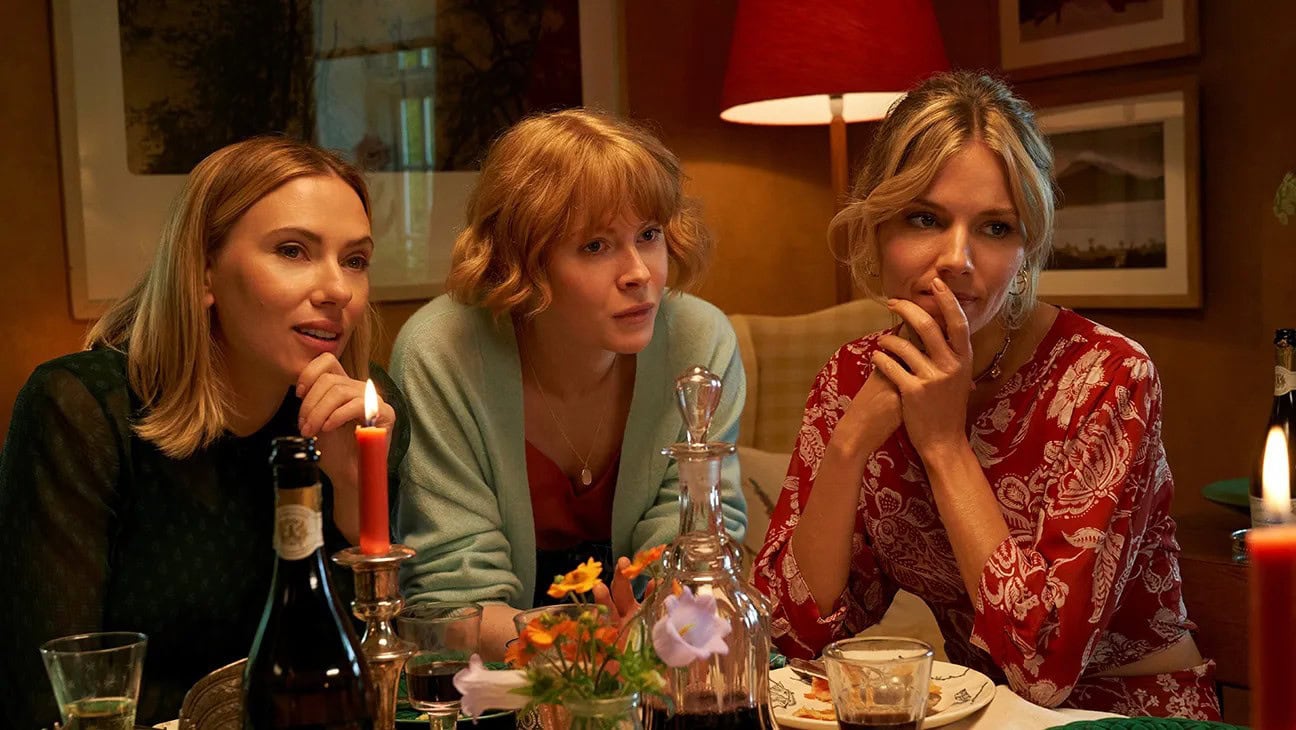
With her directorial debut, My Mother’s Wedding, Kristen Scott Thomas seeks to weave together her characters’ feelings of love, grief, and more into a poignant dramatic tapestry. But what emerges is less a finely woven cloth than a tangle of narrative strands. Starring Scarlett Johansson, Sienna Miller, and Emily Beecham as three adult daughters reuniting in England for their mother’s third wedding, the film never displays the emotional candor that would have made it feel more than just a show of prestige cosplay.
My Mother’s Wedding opens with the first of several black-and-white animated sequences that point to the memories and griefs of the characters, whose names and occupations are indicated by childlike scrawling on the screen. We meet Katherine (Johansson), a Navy captain, scrolling through old messages from Jack, seemingly a former lover. Her sisters—Victoria (Miller), a famous actress, and Georgina (Beecham), a nurse—are also en route to their mother Diana’s (Scott Thomas) country estate for the impending nuptials. Details of the family’s past are offered up in dribs and drabs by the animated sequences, such as Georgina being the daughter of the second of Diana’s deceased husbands, and serve as ghostly storyboards for a more coherent film.
When it’s revealed that Jack is not, as we’re invited to believe, a man but a woman (Freida Pinto), and that Katherine’s pain is tied to a struggling same-sex relationship, the moment should deliver an emotional gut punch. Instead, it plays like a narrative sleight of hand, designed above all else to surprise the audience. Katherine and Jack’s romance, the spine of the film’s back half given how everyone keeps discussing how the pair should get married, is barely sketched in, as we only get a few interactions between the couple once Jack arrives on the scene.
The sisterly dynamics are similarly under-baked, considering the almost peculiar attention paid to the revelation that Georgina’s husband (Joshua McGuire) has been cheating on her for years, and that Victoria once slept with him. Just as the film never reconciles its turns between farce and melodrama, its revelations register as beats to be hit rather than organic developments.
There’s no real sense of shared history between the sisters, who don’t have the lived-in rhythm, easy or otherwise, of actual siblings. Where Jonathan Demme’s Rachel Getting Married completely immersed viewers in the sometimes messy intimacies of family, My Mother’s Wedding feels more like a stage production that forgot to include its first act.
As a director and co-writer, Scott Thomas’s instincts lean toward the literal. Throughout, characters announce their traumas in stiff monologues. Emotions are underlined with close-ups of actors gazing into the distance, as if hoping that meaning might drift in from the trees. The dialogue aims for profundity—“Let go of the children you were and pay attention to the children you have”—but mostly lands with the flatness of a Hallmark movie.
My Mother’s Wedding is a personal film, as Scott Thomas has stated that it’s inspired by her own life, and one can sense the sincerity behind it. What lingers most, though, isn’t catharsis but the feeling of having watched a personal story that struggled to whip itself into some kind of shape.
Since 2001, we've brought you uncompromising, candid takes on the world of film, music, television, video games, theater, and more. Independently owned and operated publications like Slant have been hit hard in recent years, but we’re committed to keeping our content free and accessible—meaning no paywalls or fees.
If you like what we do, please consider subscribing to our Patreon or making a donation.