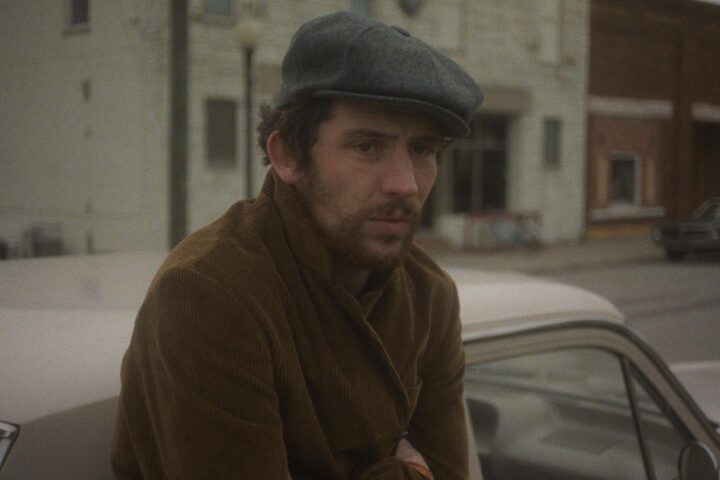
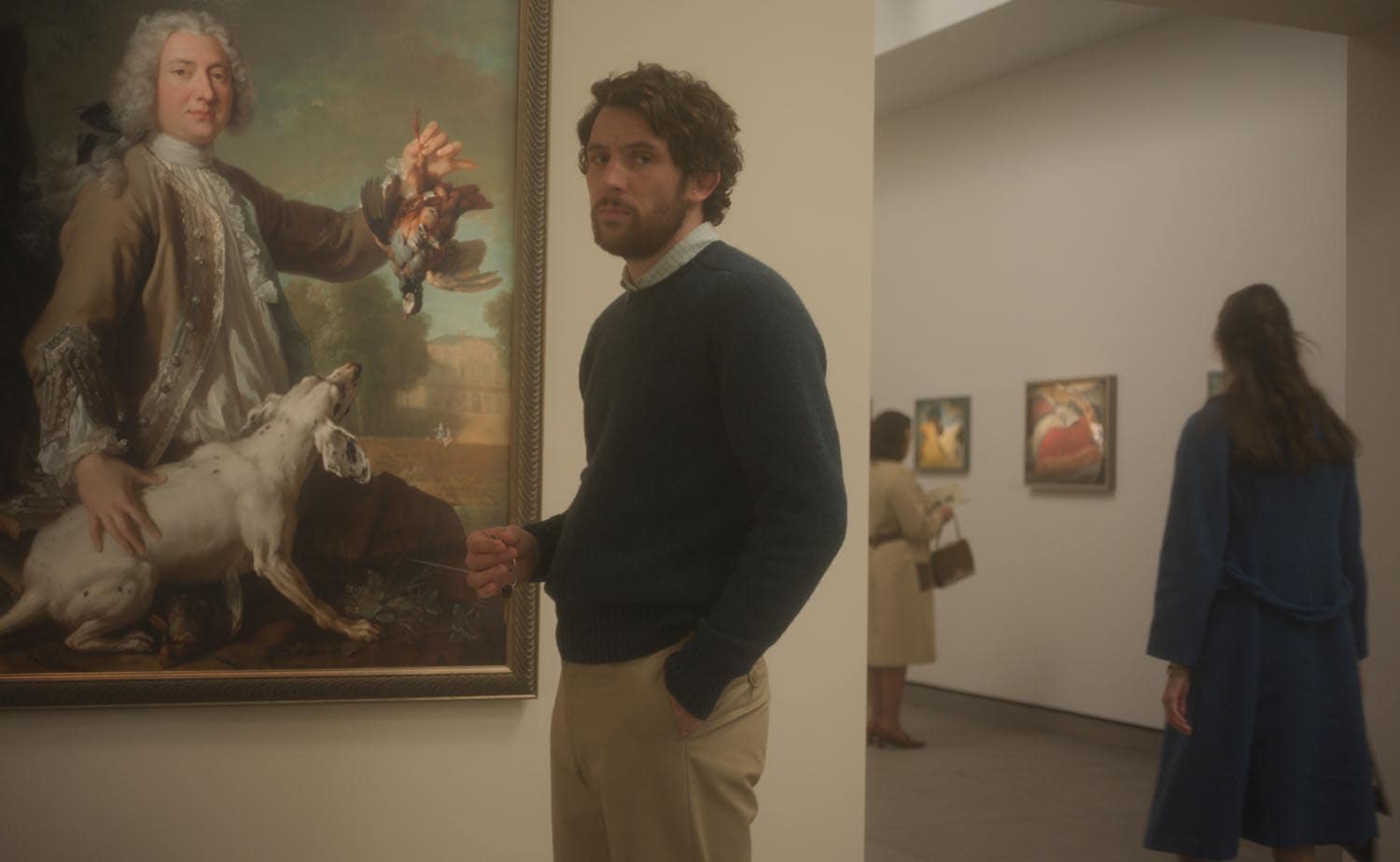
“There were times when,” Kelly Reichardt starts to say before stopping herself. She’s digging into the recesses of her brain to identify personal connections within her latest film, The Mastermind. But before the rest of that thought can formulate, the publicist who organized our interview approaches the booth where we sit at New York’s Chelsea Hotel. “Oh, look, time’s up!” she exclaims in relief. When I remark that she’s been saved by the bell like one of her students at Bard College, Reichardt mischievously laughs before offering an apology.
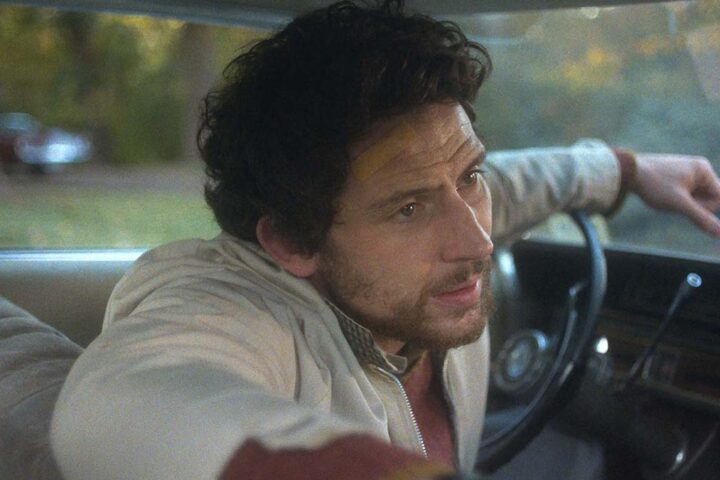
Over the course of three decades, though, Reichardt’s work has spoken for itself. Her portraits of individuals yearning for connection, whether to just another person or to society at large, have established her as the cinematic poet laureate of the Pacific Northwest. And Reichardt’s observational eye is no less keen when turned on Josh O’Connor’s amateur art thief, J.B. Mooney, and the consequences of his crimes in the Massachusettes-set The Mastermind.
Reichard frontloads the story of the film with Mooney’s audacious heist of four Arthur Dove paintings from a local arts museum so that she can send him adrift to deal with her true thematic interest. The Mastermind primarily concerns her protagonist’s attempt to cobble together a strategy for what comes after executing his best-laid plans. Set against the backdrop of 1970 and its associated sociopolitical turmoil, Mooney’s increasing distance from his community mirrors the trajectory of a nation into disillusionment and disarray.
I spoke with Reichardt on the eve of The Mastermind’s premiere at this year’s New York Film Festival. Our talk covered her collaboration process with her actors, where the conventions of genre storytelling influenced the film’s story, and why she only incorporated the political climate of an era at the periphery of the frame.
You were talking on your last press run about feeling trapped out in Oregon and simultaneously getting inspired by the Hudson Valley School and starting to see the East Coast a little bit differently. You shot The Mastermind in Ohio, but did that perspective change influence the way this film came about?
I’ve lived on the East Coast for 30 years, so it’s back and forth. The story makes sense to be a Massachusetts story, so that’s not exactly Hudson Valley. I went to art school in Massachusetts, so all things pointed to it. I knew I wasn’t gonna shoot in Oregon. [The change of scenery] was fantastic. It was exciting to check out a new place and have different light.
Why did you set the film in 1970?
There [were] a bunch of little snatch and grabs, and this is an ode to them. The one that happened at the Worcester Museum of Art happened in 1972, and that was a story of these teenage girls getting caught up in a heist. That was the first thing that pulled me into that story. For some reason, Worcester made sense to me, and I set it in 1970 for various reasons. I liked it to come at the end of the ’60s but not yet in the ’70s. The glory, the high hopes, and the craziness of the ’60s have puttered out, and people are in the fog of what comes next. I liked that as a place to be. It’s the year we went into Cambodia. It’s the year of Kent State.
How were you calibrating the ambient noise of the era’s political climate? It’s less in your face than Air America on the radio in Old Joy but still very present.
The character isn’t really tuned in to the political climate. It’s just at the periphery of his view, so I attempted to place it that way in the film, just on the edges of the frame. He’s privileged enough not to have it be at the center of his existence, so it’s not a focal point.
On the note of privilege, so many of your films are about these isolated characters on the margins living a little bit hand to mouth, and what they’re looking for is to become a part of a community and find stability. The Mastermind, in a lot of ways, feels like an inversion of that. Mooney starts where they would want to be, and then he ends up in an itinerant situation.
I don’t ever think of them in relation to each other, so that’s too neat for me…
But was that journey out of privilege something that interested you on its own?
He’s middle class, but there are guardrails that come with that. He relies on [them] and takes [them] for granted. Those things, I’m really just thinking about the character and the details of him. [Talking like] this is what you do after you do it all, talk about it in these terms. I really just thought about this character, the things he could rely on, and who would pick up the slack when he doesn’t fulfill the things he might if he were more of an upstanding character.
I’ve talked to Josh a few times as well, and I know he has a scrapbooking process where he really loves to build out a physical collection of what the character would be going through. For you as a director, what’s your role whenever an actor arrives with a process like that? Do you assist them or let them do their own thing?
That’s his business! I think actors do a lot of stuff that’s for themselves. You start getting them into their clothes, the house where they live, the car they drive, all these things like who they’re married to, who their parents are, and these things start to fall into place. That’s allowing him to respond to all the situations he’s in. We’d concentrate on his driving since he’s driving a lot.
I shared this documentary with the family, Hope [Davis] and Bill Camp, called The Plaint of Steve Kreines, which was shot later in the ’70s. It’s just [filmmaker Jeff Kreines] filming his brother moving out of his parents’ house, but it’s a great East Coast, middle-class family situation. They all drew a lot from that. It was a good thing to share, to say, “This is the organism of your guys’ world.” Dawn Sutter, the music supervisor and a friend of mine, made him some different playlists of what would be on the radio and what he might like. [I shared] lots of Dove and art information. Just because he’s not American and he’s young—[I was] just giving him things from the period that he might have encountered.
What about his wardrobe? It does feel practical and true to the period, but it felt like it taps into something iconographic like Elliott Gould in The Long Goodbye.
I mean, I was a kid in the ’70s. Amy Roth, the costume designer, and I tried to think about the East Coast. I guess we did do a little Jasper Johns kind of look for Mooney, now that I think about it. But there’s just so much to draw from footage of the period and campus life. Often, early ’70s is you think of everywhere as being what Central Park would look like, and it’s not really the case. There was a lot of research to do that was in life. We weren’t looking at ’70s movies and saying, “Let’s do this.” I’m trying to remember what Elliot Gould wears…
It’s the suit that sparked the association for me. But I think it’s probably more of people in my generation fetishizing that ’70s look that he has. There’s just an energy Mooney gives off in the knitwear.
Certainly, there were more dynamic colors with clothes. Just like with cars, there were more colors and fabrics. Look at the bar we’re at: Everything’s beige, blue, and black. That was just life—that’s not even just the movies. That’s what was fun about that time! Things just looked different. People looked different, and cars looked different. There was a lot more color involved. Some of the fabrics, not that comfortable…but, nevertheless.
You’ve mentioned Melville as a touchstone for this film. How were you approaching and tweaking or deconstructing genre, knowing that Melville is himself deconstructing the genre?
That whole New Hollywood and New Wave, I love that period of time. But it’s all boys, boys, boys behind the camera and in front of it. I like all those filmmakers, and the French filmmakers were redoing what came before in a style that fit their time, the size of the equipment they had, the budgets they had, and their state of mind. You pick your lenses, your locations, your cars, your wardrobe, your characters, and you just form your own thing. You’re bound to be repeating. It’s not like the film starts with the form of a genre, though the way the script worked is like what happens at the beginning of the movie would really happen in the second act. The genre has rules for storytelling, and it dictates where you go next and what you do.
I’m following those rules, like the character himself, [who] knows what he’s doing for the heist. He has these rules. He’s got a list of things to do. He knows how it’s gonna go. There’s a plan. But once that’s over and executed, and he doesn’t have that plan anymore, he has to just make it up. That’s what I wanted the film to feel like—that the beginning was following the rules of a certain genre at play and then have it be, more than a heist film, a coming-undone film. It would unravel, and I’d have to make up what happened next in the same way the character would. Occasionally, I look through a list of my own influences and am like, “Oh, I hadn’t really thought of that, but there’s that film.” You can’t really escape it.
Was unraveling and the idea of consequences something at the forefront of your mind as you were thinking about this story?
An early thought was to have it be an undoing story. The doing is the structure, and then the plan doesn’t work. In some ways, Night Moves has that in it. But it’s not like I’m setting out to deconstruct something. That’s what ends up happening. But there’s something with teaching, which I’ve been doing for the last 20 years, where I approach talking about film [through] just breaking stuff down. How things are put together and how they fall apart is interesting.
When you’re building a character in the mold of a silent, more introverted type, how are you working with an actor to show the process inside his head?
I just want someone to deal with the immediate situation. Because we don’t rehearse, I never see them interacting with the other actors until we’re doing it. So you just don’t know, especially if you have two fairly young youths. I don’t know what they’re going to do. Josh is driving, and he’s got other things he’s got to think about. Hopefully, all the things in his book or whatever we’ve talked about go away, and you’re just in the physical space and have to get from here to there. There are just things people have to do, and in doing that, we hope that just takes over.
I’m fascinated by some of the details that we do learn about Mooney, like his being an art school dropout. Were there discussions in terms of building a foundation of the character that you’d then give bits and pieces of to the audience?
I [wanted it to] be a film where you find stuff out after the fact. This idea of an aftermath film plays in small ways, too, just like that example. You could have an impression, then you get more information, and the puzzle comes together as opposed to getting it all up front.
The paintings Mooney chooses to steal are ones to which he has a connection. I know you’re not keen for people to read biographical details out of your work, but is that connection rooted in any personal understanding of his situation?
I couldn’t be less interested in presenting myself! I’m interested in discovering other things that aren’t familiar to me. But, constantly, there you are. I grew up in that time, and there were lots of things that came to mind that weren’t in any way autobiographical. Definitely, as a kid, [I was] just being exposed to things you probably shouldn’t be exposed to, and no one really acknowledged that. There’s some of that in there with the Tommy character [one of Mooney’s sons, played by Jasper Thompson]. But I hate tying things into myself.
Since 2001, we've brought you uncompromising, candid takes on the world of film, music, television, video games, theater, and more. Independently owned and operated publications like Slant have been hit hard in recent years, but we’re committed to keeping our content free and accessible—meaning no paywalls or fees.
If you like what we do, please consider subscribing to our Patreon or making a donation.